
Ruth Whitney: The Whole Picture
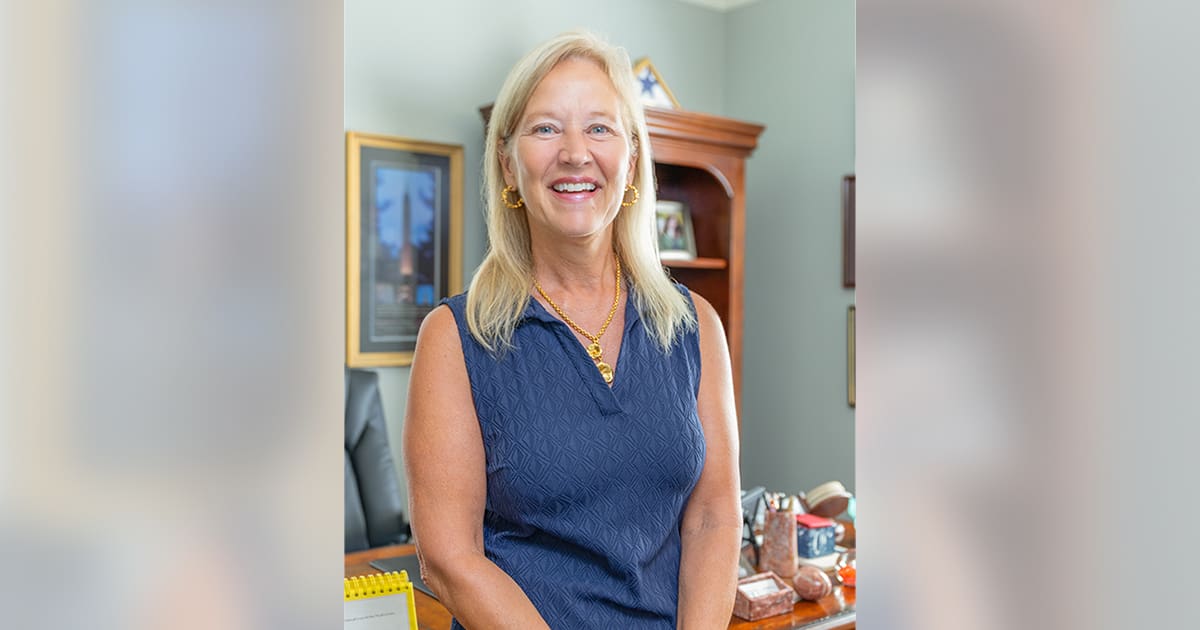
From Arkansas public service to national jury consulting and emerging technology, Bowen Law alumna Ruth Whitney ’90 has built a career as wide-ranging as the perspective she brings to every problem.
The refrigerator doors never stopped coming.
Fresh out of college and saving money for law school, Ruth Whitney ’90 spent the months between her December graduation and her first semester at the UA Little Rock William H. Bowen School of Law working the assembly line at Whirlpool in Fort Smith. Shift after shift, she installed metal components into refrigerator doors as they moved steadily down the line. The work was physically demanding. Within a month, she had worn a hole in her jeans from the constant back-and-forth motion.
Even so, Whitney wasn’t focused only on the task in front of her. She paid attention to how the entire line operated. One position near the end of the process caught her attention. Workers at the back of the line installed the final buttons in each refrigerator door, then had about five minutes before the next rack arrived. Whitney decided that was the job she wanted.
She approached her supervisor with a proposition. If she could do the job faster than the employee already assigned to it, would he let her have the position? If she lost, he could move her to the hardest job on the line. Whitney won the challenge, beating her counterpart by three buttons, and spent the rest of her time at Whirlpool working the position she had identified.
It is a story she still tells with a laugh, but it also offers an early glimpse into the way Whitney approaches the world. Rather than accepting a process as it existed, she stepped back, studied the system and looked for a better solution.
Law school had not always been the plan. Whitney studied political science at the University of Arkansas and initially hoped to pursue international relations. She was accepted to George Washington University, but financially it was out of reach. Facing a difficult job market after graduation, she began considering another path. Friends encouraged her to take the LSAT with them. Whitney researched the possibility and decided law school was a practical next step.
That decision brought Whitney to Bowen, where she found more than an education in legal doctrine. She credits the law school with sharpening her critical thinking and teaching her to see multiple sides of a problem. That came through both instruction and experience, with opportunities to put legal principles into practice through trial advocacy, clinic work and other courses.
“To me, what’s paramount in the law is your ability to think of not just one side or two sides, but multifaceted sides,” she said. “It really teaches you to think critically, deeply and tactically, as well as strategically about a problem.”
The lessons were reinforced by professors she can still describe decades later. Robert Wright, who taught property law, made preparation nonnegotiable. “You were prepared, or you got called out,” Whitney remembered.
Professor Murray, who taught the Uniform Commercial Code, remains in her memory for a different reason. She can still hear his Georgia accent as she recalls being asked to stand and recite a section of the UCC, but what she remembers most clearly is his patience. Whitney remembers him as gifted, thoughtful and kind—the kind of professor willing to stay with a student who did not yet understand a concept.
Her legal education gave Whitney both legal knowledge and, as she puts it, a measure of professional credibility. But its more enduring influence may have been less visible. The instinct to look beyond the immediate question had been there before law school. Bowen gave her a more rigorous way to do it.
Whitney had plenty of opportunity to test that way of thinking at the Arkansas Department of Human Services, where she spent 13 years working across law, policy and management. Her early legal work included childcare licensing, juvenile court and adult protective services, taking her into courthouses across western Arkansas and into cases involving some of the state’s most vulnerable children and adults.
The work could be difficult to absorb. Whitney describes the juvenile and adult protective services cases as deeply difficult, but when she talks about that period, her attention quickly shifts to the social workers and others working directly with the people those systems were designed to protect. She calls them “the unsung heroes,” people who needed resilience, strong minds and big hearts to carry that responsibility. “I felt like it was a real opportunity for me to serve in that way,” she said.
Over time, the boundaries of the work widened. When Whitney learned that the department had an opening in public policy, she called the director, whom she did not know personally, and asked for an interview. She got the job, moving from legal work into a role that allowed her to work across the agency and encounter issues ranging from Medicaid policy and services for people with developmental disabilities to childcare, youth services and the operations that supported them.
What appealed to her was the breadth. Whitney describes public policy as a place where federal law, state law, regulations and rules meet the agencies responsible for putting them into practice. Her work also meant operating within a system that included the governor’s office, the Legislature, boards and commissions, alongside people who had spent careers mastering the details of programs such as Medicaid and SNAP. “I loved the opportunity to learn the vastness of public policy and the range of knowledge that it takes to do that work day to day,” she said.
Eventually, her responsibilities included county operations across all 75 Arkansas counties. The statewide view brought policy back to the people affected by it. Whitney traveled Arkansas and saw how residents received services such as SNAP and Medicaid, and she remembers the emergence of ARKids First as an effort to reach working families who still could not afford health care.
Whitney’s subsequent work took her into the private sector and then to the Arkansas Attorney General’s office, where she served as chief of staff to then-Attorney General Mike Beebe.The role placed her at another intersection of law and public life, where she worked with the press, the Legislature, the governor’s office, boards and commissions. Those experiences gave her a closer view of how legal decisions, public policy and communication affect both government and the private sector.
She eventually drew those experiences together in a company of her own, founding inVeritas. Through the firm, Whitney built a consulting practice that brings research, public policy, communications, advocacy and strategic planning together to help clients navigate complex issues. She does not describe the company as an answer to a single problem she had identified. “It was less about a specific problem and more about a collection of my journey,” she said.
At inVeritas, the work begins with gathering intelligence: understanding an issue as fully as possible before advising a client on communication, crisis response, advocacy or strategy. “We learn every facet of an issue we possibly can,” Whitney said. That can include public opinion or market research, but the information is meant to lead somewhere: to a clearer understanding of the problem, a deliberate plan for addressing it and, ultimately, execution.
As inVeritas grew, Whitney became equally intentional about the people around her. She believes strong teams are built by bringing together people with complementary strengths, not by expecting one person to have every answer. “The success of a business is the people and the team that you put together,” she said. “I just have the privilege of leading that team.”
Whitney later built on the jury selection and litigation support work she and her team were already doing, founding Select Litigation. It is an unusually specialized business. She and her team can enter a case before trial, study the community and prospective jury, help attorneys think through opening and closing arguments, prepare witnesses and, in some cases, remain involved as the trial unfolds. The work has taken them into jurisdictions across the country.
Select Litigation grew naturally from the research, public opinion work and data analysis already embedded in inVeritas. Depending on the case, the team may use focus groups, mock trials, community polling and publicly available information to better understand the jurisdiction and the people who may ultimately decide the case.
But the work is not just analytical. Whitney describes it as both behavioral and scientific because jurors do not encounter a case as blank slates. They bring their culture, education and personal experiences with them, and those experiences affect how they receive the people and information in front of them. For Whitney, understanding the data is important, but so is understanding the people behind it.
That balance between data and human judgment would become even more important as artificial intelligence began appearing more frequently in Whitney’s newsfeed. She started reading, seeing more discussion about its potential impact and the resources being invested in its development. Rather than waiting to see what it would mean for her businesses and clients, Whitney decided she needed to understand it. She received certification in AI through Saïd Business School at the University of Oxford in England and was convinced that her team needed to prepare for a technology she believed would significantly change the way people work.
It was not her first experience at Oxford. As a Bowen student, Whitney spent a summer studying international law at Magdalen College, one of the colleges that make up the University of Oxford. She remembers travel as an important part of education, one that exposed her to different legal, educational and social systems and to people who approached the world differently.
That perspective shapes the way Whitney talks about AI. Technology may be able to make work faster and more efficient, but she does not see technical ability as a substitute for human judgment. “There is no substitute for being able to look at someone, know how they are reacting, understand how they’re feeling and ask the right questions,” she said. Used well, she believes technology can streamline parts of the work and leave people with more time to think creatively and strategically and to develop the interpersonal skills and relationships their work requires.
Whitney has carried that philosophy into inVeritas’ work with organizations adopting AI. Her team has been certified in the technology and works with businesses in Arkansas and elsewhere on how to use it effectively and responsibly. For Whitney, the technology is new. The underlying question is familiar: how can better tools help people make better decisions without losing sight of the human judgment those decisions still require?
That emphasis on people is not limited to Whitney’s professional work. For her, service is not a separate chapter of her career. It reaches back to the family that shaped her earliest ideas about responsibility to others.
Her mother was a nurse and her father a minister, and she describes growing up in a family oriented toward caregiving. Her brother Tim has developmental disabilities, an experience that helped shape the family’s understanding of advocacy and service. “My mom and dad’s gentle guiding hand on all of us taught us the importance of advocating not only for Tim, but for others, and giving back in a meaningful way,” Whitney said. “I think that’s been the thread for me from a very early age.”
That thread has remained closely tied to Arkansas. Whitney has volunteered for years with the Access Group, whose work with people with developmental disabilities is especially personal because of her brother. Hunger relief reaches back even further. As a child in Fort Smith, she volunteered with the Clearinghouse, an organization that helped people with needs including food and shelter. As an adult, she continued working on hunger relief efforts in Arkansas, including Serving Up Solutions, a fundraiser supporting that work.
Her involvement with the Little Rock Regional Chamber of Commerce reflects another part of that commitment. Whitney, who serves as the Chamber’s 2026 chair, calls it the “economic side” of her passion. As an entrepreneur, she sees strong businesses and strong communities as connected, and she has remained invested in helping Little Rock and Arkansas become places where people can live, work and build.
When Whitney describes how she approaches a difficult problem, she reaches for an image. She tries, she says, to think about a problem “in 360,” resisting the limits of whatever information is immediately visible. To explain it, she describes traveling through a tunnel. From inside, only a small circle of light is visible ahead. Move beyond it, and the landscape opens.
Whitney is not interested in perspective simply for the sake of seeing more. The point is what a broader view makes possible. She describes problem-solving as both intellectual and human, requiring creativity, information and an understanding of relationships. Often, she says, the goal is not a perfect outcome for one side, but a solution that allows both sides to move forward with some measure of success.
When Whitney reflects on the people, education and experiences that have shaped her, the word she returns to is gratitude. Her greatest joy, she is quick to add, is not professional at all. It is being a mother. Whitney speaks proudly of her two children and of finding work that she loves, even knowing that every profession brings difficult days. “If you love it and you love your work, oh man, what a gift,” she said. “But being a mom and having that experience, there’s nothing like that.”
Whitney’s attention to people is as evident in the small moments as it is in the larger work. She asks questions, remembers details and makes room for the stories and experiences of others. She speaks easily about the people, places and memories that have shaped her, from learning to fly-fish with her father to her Bowen graduating class and time at Oxford. The instinct that has carried her through courtrooms, government offices, boardrooms and new technologies is present there, too: before settling on what is in front of her, Whitney keeps looking for the rest of the picture.