
CHASSE Announces 2025 Faculty Excellence Winners
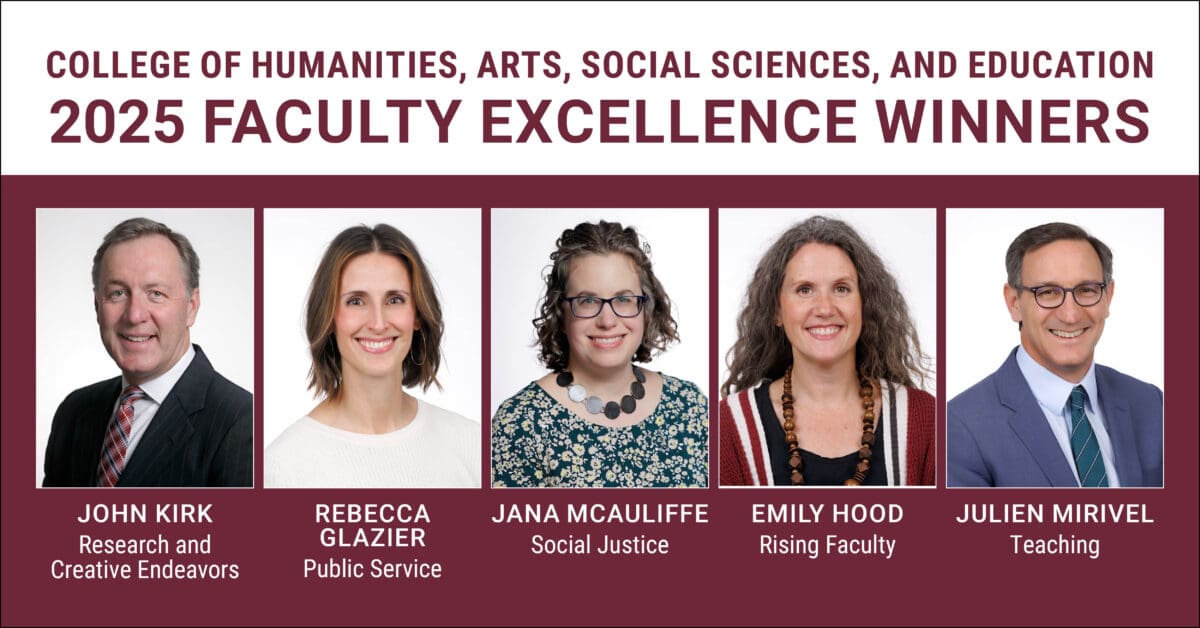
The College of Humanities, Arts, Social Sciences, and Education announced the five recipients of the college-level 2025 Faculty Excellence Awards.
Professors Rebecca Glazier, Emily Hood, John Kirk, Jana McAuliffe, and Julien Mirivel were named winners by the college’s Faculty Excellence Awards Selection Committee.
The college recipients will be recognized at the UA Little Rock Faculty Excellence Awards on Thursday, April 3, and the university-level recipients will be announced.
Rising Faculty Award for Excellence
Dr. Emily Hood received the college’s Rising Faculty Award for Excellence. An assistant professor of art education, Hood joined the School of Art and Design in the fall of 2021.
This award is given to faculty members in their first five years at UA Little Rock who display exceptional promise in teaching, research or creative endeavors, or public service. For Hood, her work intersects across all three.
Among updating the Art Education curriculum to better serve future contemporary art educators, Hood has also shifted the program to a cohort model to promote a sense of community among the students.
“Dr. Hood, as a role model, demonstrates effective teaching strategies and also creates a professional environment that is always inclusive, productive, and encouraging,” a former student writes. “I am also grateful that I have the ability to reach out and ask for help from my professor even after I have graduated.”
In addition to her teaching, Hood’s research involves young disabled artists and documenting their relationships to art materials in an art studio setting. This research led to the creation of a course that involves a field placement for students at Easterseals Academy.
“Her innovative teaching, both in and out of the classroom, her student mentorship, and her commitment to building strong relationships with students, campus resources, and broader community members makes her an excellent candidate for this award,” her nomination letter states.
Faculty Excellence Award for Public Service
Dr. Rebecca Glazier received the college-level Faculty Excellence Award for Public Service. A political science professor in the School of Public Affairs, Glazier has been at UA Little Rock for 15 years.
The recipient of this award applies their skills to their disciplines in service to the community, state, or nation in areas of public interest. In 2012, Glazier started a research program focusing on the intersection of faith and community called the Little Rock Congregations Study.
“Her careful attention to the needs and interests of the populations she studies, her production of numerous resources and events to benefit those partners, and the subsequent positive impact on the Little Rock community make her an ideal candidate to receive this award,” one peer wrote.
Glazier utilizes her research expertise in religion and community engagement to advance knowledge in areas of public interest and offer students hands-on experiences.
The data from her studies have been released to the public and her work has been recognized through a national award for Civic and Community Engagement from the American Political Science Association.
“Dr. Glazier goes above and beyond to provide mentorship, guidance, and support, whether by assisting students with research, offering career advice, or dedicating her time to community initiatives,” a former student wrote.
Faculty Excellence Award for Research and Creative Endeavors
Dr. John Kirk is the recipient of CHASSE’S Faculty Excellence Award for Research and Creative Endeavors. As a George W. Donaghey Distinguished Professor of History, Kirk has taught at UA Little Rock for 14 years.
The Faculty Excellence Award for Research and Creative Endeavors is given to those who have contributed to the expansion of knowledge and the quality of life in a particular area. During the past five years, Kirk published his ninth and 10th books.
His most recent book, “Winthrop Rockefeller: From New Yorker to Arkansawyer, 1912-1956” won the 2024 Booker Worthen Literary Prize from the Central Arkansas Library System for best work of fiction or nonfiction by an author living in Arkansas and the 2024 John G. Ragsdale Book Award from the Arkansas Historical Association for the best book published in Arkansas History.
“To provide a new generation of students and scholars with such diverse and important voices on a topic that continues to evolve in the twenty-first century is testament to John’s ability to promote knowledge exchange and research,” a lecturer in U.S. History at University College London wrote.
Along with his published books, Kirk also regularly contributes to a number of newspaper articles, magazine articles, radio programs, and podcasts. Not only does he produce this work himself, but he also invites his public history students to contribute alongside him to further their academic careers.
“In addition to being one of the nation’s foremost historians and researchers, Dr. Kirk has served as an ambassador for UA Little Rock with his many radio, television, and speaking appearances,” one letter of endorsement states. “He has been a guest on my podcast and never fails to [make] the university proud.”
Faculty Excellence Award for Social Justice
Dr. Jana McAuliffe was named the college’s recipient of the Faculty Excellence Award for Social Justice. An associate professor of philosophy in the School of Human Inquiry, McAuliffe has taught at UA Little Rock for nearly a decade.
This award is given to a UA Little Rock faculty member, regardless of years served, whose advocacy spans across teaching, service, and research.
McAuliffe describes her research process as “first [explaining] the meaning of challenging, complex ideas from the philosophical tradition and then [putting] these ideas to work to help address the problems of the present.”
Over the past five years, she has taught courses such as “The Philosophical Life,” “Ethics and Society,” “Philosophy of Law,” “Reasonings Across Disciplines,” and many others.
“Her reading lists demonstrate deliberate and concerted effort to represent a variety of perspectives and background, and her syllabi include a wealth of helpful information aimed at ensuring that all of her students have the resources they need for educational success,” her nomination letter states.
In addition to her teaching and research, McAuliffe contributes to public service as the director of the Ethics and Philosophy Summer Academy and as the faculty mentor for student groups that prioritize supporting and strengthening community.
“She not only provides an astute analysis of economic, political, and social problems as part of her research agenda, Dr. McAuliffe consistently and ably carves out spaces to increase opportunities for those in need and to inspire others to consider their own responsibilities in the creation of a more just world,” one of her peers said.
Faculty Excellence Award for Teaching
Dr. Julien Mirivel received the college’s Faculty Excellence Award for Teaching. A professor in the Department of Applied Communication, Mirivel has been at UA Little Rock for 19 years.
In the past five years, he’s taught courses in the department such as “Introduction to Communication,” “Communication and Community,” “Interpersonal Communication,” among many others.
The Faculty Excellence Award for Teaching is given to exemplars of the teacher/mentor model who maintain high expectations of their students.
“Today, Dr. Mirivel’s teaching is centered on creating transformative experiences for students, in both his face-to-face and online classes, empowering them not only to acquire knowledge but also to develop the skills and values necessary for personal and professional growth,” his nomination letter states.
Mirivel’s research on positive communication led to the creation of the widely recognized Positive Communication model and the Positive Communication Network, which he utilizes as the foundation for many of his courses. The model blends the creation of thoughtful relationships with conducting research.
“His ability to blend intellectual rigor with genuine human connection fosters an environment where students feel challenged, supported, and inspired,” a former student said.