
UA Little Rock Student Launches Balloon Program to Inspire High School STEM Learning

A University of Arkansas at Little Rock student is reaching new heights with a unique balloon-launching initiative aimed at sparking high school students’ interest in Science, Technology, Engineering, and Mathematics (STEM) initiatives.
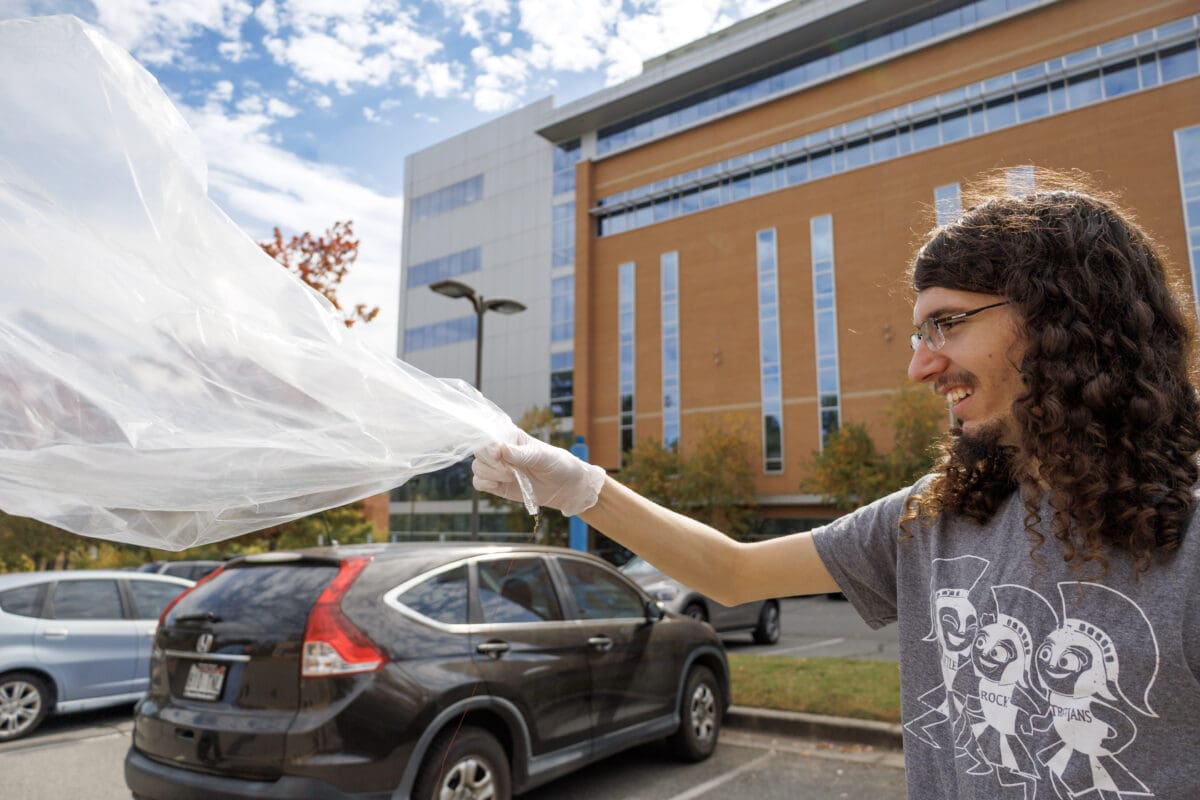
As a project of UA Little Rock’s Aerospace Club, Will Fausel, a sophomore electrical and computer engineering major from Sherwood, has been launching small balloons from campus that can be used for scientific research, with his faculty mentor, Dr. Bruce Bauer, a senior instructor in information science.
They are known as Pico balloons, lightweight plastic helium balloons which contain a lightweight amateur radio transmitter that are used for long duration ballooning. These types of research balloons can reach heights of up to 60,000 feet, which allows for stratospheric access.
The balloons are equipped with a beacon that transmits GPS and altitude that can be picked up by radio operators on the Weak Signal Propagation Reporter (WSPR), a protocol which is used for weak-signal radio communication between amateur radio operators. The data is then uploaded to the internet, where Fausel and Bauer can track the balloon’s progress.
They’ve had mixed success with their four launches. The first balloon traveled nearly 1,800 miles over three days. They’ve had the most success with the second balloon released in October, which traveled more than 11,000 miles over five days and 19 hours. The last radio signal was picked up somewhere around Perth, Australia. The third flight, sadly, never made it off campus as the wind blew it into a tree. And the most recent flight traveled 530 miles over three days to North Carolina.
“The beacon transmits every two minutes, so that’s how often we can receive updates,” Bauer said. “Powered by two solar cells, the beacons can’t transmit at night. We launched the first balloon in April 2024 and aim to reach a schedule of launching a balloon every couple of weeks. In the future, these Pico balloons can carry sensors for additional measurements and even conduct experiments.”
Fausel has received a Signature Experience Grant from UA Little Rock for the 2024-25 school year, which allowed him and Bauer to continue building and launching more balloons. They are trying to determine how best to launch the balloons to ensure a successful journey, what materials to use that can make the project more affordable and long lasting, and what research can be done with the balloons. They have a goal of launching a Pico balloon that will circumnavigate the Earth.
“We aim to turn this project into an outreach program for high schools across Arkansas, especially those with limited access to STEM hands-on resources,” Fausel said. “Each launch is designed to be simple, reliable, with no need for FAA approval, and affordable, costing less than $100. We will soon be ordering more beacons to facilitate more complex launches. There’s a lot to consider on this front.”
The program, which starts with small-scale launches, envisions providing pre-built balloon kits for high school classes, giving young learners a hands-on STEM experience without needing FAA approval or expensive equipment.
Fausel is also planning to apply for a grant from the Arkansas Space Grant Consortium to continue to develop his high school initiative. If he receives the grant, Fausel and his group will have the resources and connections to begin collaborating with high schools while creating ballooning kits.
Fausel envisions that these ballooning kits can be used by a high school teacher for a week-long lesson that culminates with the class assembling, launching, and collecting data from their own Pico balloon from the kit. Students can learn about topics like radio propagation, programming, GPS, gas buoyancy, basic electronics, weather data, and more.
The next Pico balloon launch will be on Friday, May 2, depending on the weather. Updates on time and location will be posted on the Aerospace Club Group Me
Contact Fausel at [email protected] or Bauer at [email protected] for more information.