
UA Little Rock Professor Honored with International Award for Pioneering Materials Research
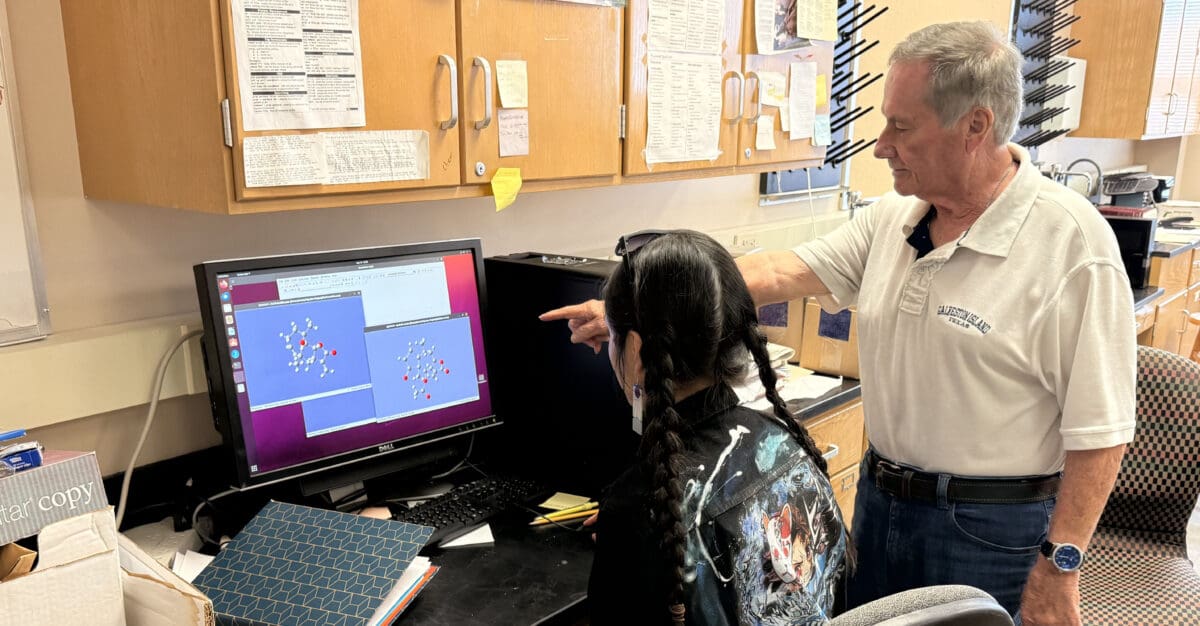
It may be one of the best-kept secrets in Arkansas. Inside a lab at UA Little Rock, chemistry students are designing everything from Alzheimer’s and migraine drugs to next-generation materials stronger than Kevlar. The work, led by Dr. Jerry Darsey, is gaining international acclaim, most recently with an award from the International Society of Advanced Materials in Stockholm, Sweden.
The Advancement of Materials to Sustainable & Green World award highlights the university’s Center for Molecular Design and Development, where Darsey and his team are developing cutting-edge methods to design high-tech materials and drugs using artificial intelligence and quantum calculations.
In addition to receiving the award, Darsey, a professor of chemistry and applied science at the University of Arkansas at Little Rock and the director of the Center for Molecular Design and Development, recently served as keynote speaker at the International Conference on Mass Spectrometry and Separation Techniques in Paris, France. These invitations reflect the global impact of his work and that of the university.
“It is more recognition for the university and what we are doing at our center,” Darsey said. “They said that our work is ‘pioneering.’ We are using a combination of quantum calculations and AI to develop advanced materials. I didn’t realize how unique our practices were until I started getting invitations to speak.”
Since founding the center in 1995, Darsey has been invited to present his research around the world, including Australia, Scotland, England, Poland, France, and Sweden.
What is applied science? It means translating complex theory into practical solutions that benefit industry, medicine, and the community. Darsey’s team specializes in computer modeling to design new materials and drugs with specific properties. The work done in his lab could revolutionize medicine and other initiatives on a global scale.
Pioneering Research in Applied Science
“What we do is we put a molecule into the computer,” he explained. “Then, through the combination of AI and the most powerful quantum calculations, we can design new molecules with any properties desired. If you wanted steel alloy that has twice the strength of any material currently known, we should be able to design that.”
Their methods have already produced promising results in both drug discovery and materials development:
- Medical Advancements: Darsey’s lab has designed potential drugs for treating Alzheimer’s disease, Parkinson’s disease, and other conditions, supported by funding from organizations like the Michael J. Fox Foundation.
- Agricultural Impact: Darsey’s team is also developing herbicides to combat weeds in rice crops, aiming for formulas that are 10 times more potent yet require significantly lower dosages, reducing harmful side effects.
- Stronger, Smarter Materials: From lightweight plastics with the strength of steel to alternatives stronger than Kevlar, Darsey envisions a future for the lab where advanced materials transform industries from automobiles to defense.
Students at the Center of Discovery
One of the most distinctive aspects of Darsey’s work is how central his students are to the process.
“They do the work,” he said. “I take six months teaching them how to do it, and once trained, they do all of the research. My best student, Micah Shaver, knows how to do everything. I come up with the ideas and they execute.”
This hands-on approach not only trains students in advanced techniques but also gives them opportunities to present research internationally. Shaver, the project director at Darsey’s center who is studying for her master’s degree in chemistry, will present her migraine drug research at a conference this October. She said working with Darsey has empowered her research and opened up doors to collaboration.
“All the projects I’ve done are molecular modeling combined with AI,” she said. “Beacuse of Dr. Darsey, I’ve been able to present my work nationally and work with other chemists across the world because of his connections.”
Shaver said in addition to her drug research work, she is also working to improve how we fertilize crops by creating herbicides and fungicides to be “more potent and less environmentally impactful.” She said Darsey’s connections have allowed her to collaborate with other scientists to provide a broader scope of research and knowledge to her work.
The international exposure has also attracted students to UA Little Rock. Darsey recalls a student from Barcelona, Spain, who heard of his research abroad and later sought out opportunities in his lab.
What’s Next?
Darsey has ambitious goals for the next decade, including designing high-temperature superconductors that could revolutionize medical equipment like MRI machines and enable faster, more efficient transportation.
Despite these global ambitions, he emphasizes that recognition ultimately benefits the university and its community.
“We’ve never attacked a problem that we haven’t been able to find a solution to,” he said. “It’s not as important to get my name out there, but our center. We have faculty on our campus that can design superior properties than what is currently being used. That recognition helps us attract funding, students, and opportunities.”
As awareness of the pioneering work continues to rise, Darsey is planning a fundraising event for early next year to support future research and student engagement.