
UA Little Rock Professor Featured in National Documentary Project for America’s 250th Celebration
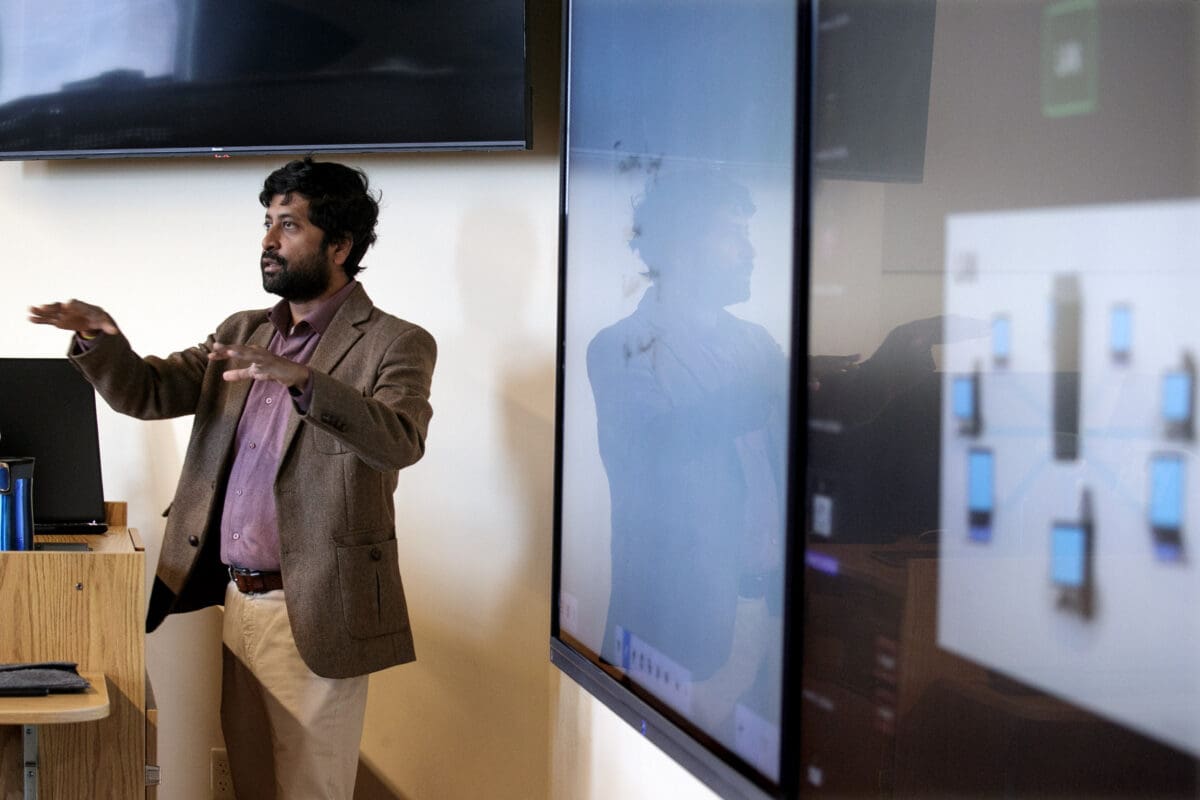
Dr. Arya Basu, assistant professor of computer science at the University of Arkansas at Little Rock, has been selected to participate in “Our American Story,” a national documentary initiative honoring the people and ideas shaping the United States ahead of its 250th anniversary in 2026.
As part of the America 250 celebration, the “Our American Story” project aims to create the largest audiovisual archive of American stories ever assembled. The archive will be preserved in the Library of Congress as a living time capsule for future generations. Each participant shares their journey, values, and vision for America’s future, contributing to a collective portrait of innovation and perseverance across all 50 states.
Dr. Basu was the only researcher from Arkansas interviewed for the project and the only UA Little Rock professor featured. The interview took place at the Old State House Museum in downtown Little Rock on Oct. 6, a setting Basu described as “aptly chosen and soaked in history.”
“I was speechless and spellbound,” Basu said. “Even now, I can’t believe they found my story. Being part of America’s 250th celebration is an honor I never imagined.”
A computational scientist specializing in human-computer interaction and biomedical visualization, Basu’s recent research explores cardiac visualization technologies inspired by deeply personal experiences. His mother’s difficult heart surgery and the passing of his uncle, an applied physicist who inspired Basu’s early interest in science, motivated him to pursue research that bridges technology and human health.
“My uncle had a huge impact on who I am as a scientist,” Basu said. “Those experiences with my family taught me that science, like life, is about compassion and persistence.”
During his interview, Basu reflected on his journey from India to Arkansas and how the state’s natural beauty and pace of life have shaped his work and mindset.
“When I first crossed the Mississippi River into Arkansas, I was struck by the abundance of trees and the sense of peace,” he said. “Science, like good soul food, comes from a soul that is at peace with its environment. The South is known for its warmth and music, but it’s also a place where good science happens.”
When asked what message he hoped to leave for America’s 250th birthday, Basu emphasized the value of perseverance in science and in nation-building.
“Persistence is what keeps this nation moving forward,” Basu said. “Building a nation is not easy, and maintaining one is even harder. For the next 250 years, I hope we never lose sight of the need to stay persistent in pursuing what our collective hearts know is right and important.”
Looking ahead, Basu’s next line of research centers on human decision making and spatial reasoning, including studies of maze navigation and the use of eye gaze signals to improve artificial intelligence for Air Force mission needs.
Basu said being featured in “Our American Story” is both humbling and deeply meaningful. His family, he added, was thrilled to learn that his story would be preserved in the Library of Congress.
“My family is over the moon,” Basu said. “Some of them joked that I must be going into politics. But truly, they’re proud that something from our story is now a part of American history.”
For Basu, the experience reaffirmed his belief that science, compassion, and creativity are threads that unite all Americans.
“Science has no borders,” he said. “It’s not just where you are that matters. It’s what you strive to contribute to the world. Being part of this project reminds me that every story, no matter where it begins, can inspire something greater.”