
UA Little Rock Battery Lab Powers Arkansas’s Future in Energy Independence
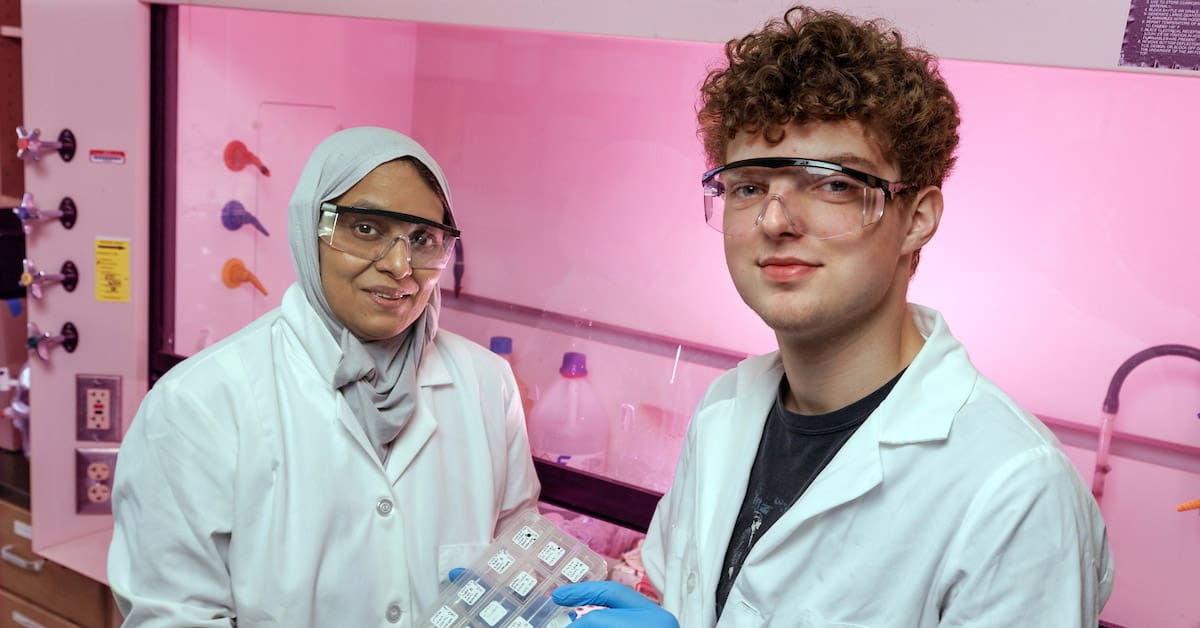
As demand for cleaner, longer-lasting energy storage grows, researchers at the University of Arkansas at Little Rock are leading the charge toward innovative next-generation battery technology. At the heart of that effort is Dr. Noureen Siraj, associate professor of chemistry, who recently established the university’s new battery research laboratory – the first of its kind in central Arkansas.
Siraj’s research focuses on three key components of the battery: the anode, the cathode, and the separator. Together, these parts determine how much power a battery can store, how long it lasts, and how safely it operates. Her lab is developing a new type of high energy density battery to increase performance and longevity. Specifically, she looks to improve the life cycle, energy density, voltage capacity, and thermal stability of batteries.
Siraj’s work on developing the separator – which prevents the two electrodes in the battery from connecting and short-circuiting – has gained recognition from prominent players in energy development. This work specifically has gained funding from the NASA Arkansas Space Grant Consortium.
By developing safer and more durable batteries, Siraj is not only increasing efficiency but also reducing waste and cost for everyday consumers. She said her research has potential developments for electric vehicles. “We want to improve the life cycle of batteries. If we are able to reach 10,000 hour cycles, they could last up to 25 years, meaning you wouldn’t have to replace the battery in your car within your lifetime,” Siraj said.
Her lab collaborates with U.S. Vanadium and Standard Lithium, two major companies advancing energy innovation in Arkansas. These partnerships connect university research with industrial development, creating opportunities for students to apply their knowledge beyond the classroom and presenting unique opportunities for internships.
Inside the lab, students gain extensive hands-on experience with material synthesis, characterization, and advanced instrumentation. They also learn valuable skills for communicating about their research to both technical and public audiences. Senior students participate in proposal writing and learn how to secure research funding – training that, Siraj said, helps them “become independent researchers by the time they graduate.”
Siraj’s passion for her project goes far beyond science, however. Mentorship is as central to her mission as scientific discovery. As an instructor and researcher, Siraj takes joy in producing students with critical thinking skills and independence. “I will see that as the greatest success of my life,” she said. “My greatest joy comes from seeing my students succeed. It fills me with pride and purpose. When they struggle, I can’t help but feel like I am falling short somehow. I feel incredibly proud and fulfilled because of everything they’ve achieved. Their growth is my biggest reward.” Her PhD students have gone on to careers in prominent national laboratories such as the U.S. Food and Drug Administration, the Department of Energy, and the Arkansas State Crime Lab. She also serves as a Chemistry Olympiad coordinator, going beyond the collegiate setting to directly engage with the local community. Students as young as fifth and sixth grade have worked on projects with Dr. Siraj, who seeks to spark a love for STEM research in all she teaches.
Siraj views her research as a way to cement Arkansas’s status as a leader in energy production and innovation. The development of longer life cycle batteries would be a complete game changer for human energy use. With the discovery of lithium reserves in southern Arkansas, she sees an opportunity to connect local resources with cutting edge research, positioning Arkansas at the forefront of these technological developments. Siraj said, “If we are able to go all the way from the extraction of lithium to the utilization of that lithium in the batteries, then Arkansas will stand out in the whole United States.” In order to continue meeting our energy demands, she said we must seek out alternatives to our dwindling energy sources – and perhaps the future of energy is right in our backyard.
By connecting research and real-world application, Siraj’s battery research laboratory is helping position UA Little Rock – and the state of Arkansas – as a rising leader in energy independence and innovation.