
UA Little Rock Student Broadens Horizons Through Study Abroad in Uruguay
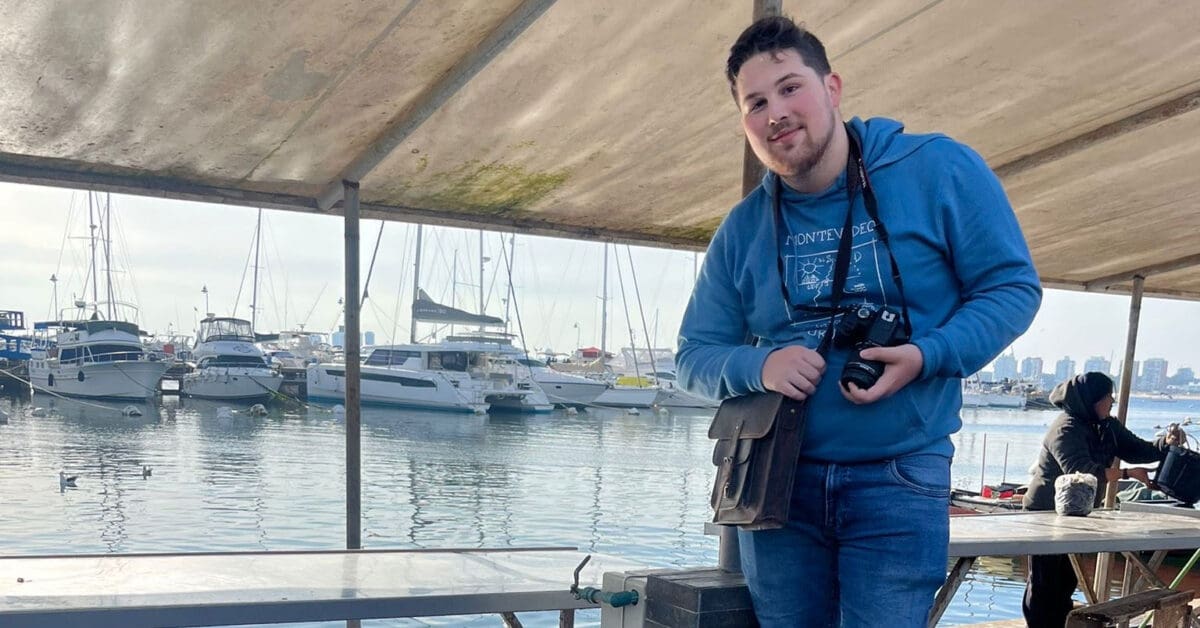
UA Little Rock student Josh Wynne-Hudson spent part of his summer studying thousands of miles from home and came back with lessons that will shape his future career.
Wynne-Hudson, an ASL/English interpretation major from Joplin, Missouri and member of the Donaghey Scholars Honors Program, spent five weeks in Montevideo, Uruguay, studying Latin American history and culture, the social dimensions of health in Latin America, and experiencing the country’s vibrant culture firsthand. He participated in the summer program at Universidad ORT Uruguay, the country’s largest private research university, in May and June.
“When I started looking into study abroad programs, I didn’t have a specific destination in mind,” Wynne-Hudson said. “Because my major is in American Sign Language, my options were more limited, but I wanted something that was culturally relevant and interesting. The more I learned about Uruguay — from its renewable energy efforts to its high literacy rate and great quality of life — the more I wanted to experience it for myself.”
The university’s study abroad program combined academic coursework with rich cultural immersion. Wynne-Hudson and his classmates toured Montevideo’s Ciudad Vieja “Old City,” a historic area filled with art, architecture, and street vendors. They explored Sierra de Minas, where Wynne-Hudson faced his fears on a ziplining adventure and learned about Uruguay’s elaborate tea rituals by preparing yerba mate. Other excursions included visits to the Parliament building, the zoo, and several local food tastings.
“Montevideo is such a vibrant city,” he said. “You can walk around and find new events, new people, and new things to do every day. I especially loved the street markets, called ferias. I’m really into antiques, and I ended up finding a lot of antiques and vinyl records.”
Living in an apartment during his stay gave Wynne-Hudson a firsthand look at daily life in Uruguay as well as an opportunity to navigate language barriers.
“Living in a place where Spanish isn’t my first language was sometimes daunting, but it was also incredibly rewarding,” he said. “It pushed me to improve my communication skills and become more adaptable, which is really important in my future career.”
Wynne-Hudson said one of the most valuable parts of the experience was learning how to overcome communication challenges — a skill that’s essential for interpreters.
“This trip really helped me get more familiar with how to handle communication barriers,” he said. “That’s such an important part of interpreting, and it’s something I couldn’t have learned as effectively in a classroom.”
The experience also took Wynne-Hudson beyond Uruguay’s borders. He visited Buenos Aires, Argentina, where he toured museums and connected with Argentinian Sign Language interpreters.
“It was fascinating to see the similarities and differences in sign language use,” he said. “I recognized a lot of the signs, and talking with them gave me new insights into how sign language is used in other countries.”
For Wynne-Hudson, the trip was a transformative journey that expanded his worldview and prepared him for his future as an interpreter.
“Being immersed in another culture and navigating communication differences gave me tools that will help me throughout my career,” he said. “It would be amazing to go back someday with the benefit of hindsight and everything I learned on this trip.”