
UA Little Rock Leads Nation in Preserving Native American World War I History
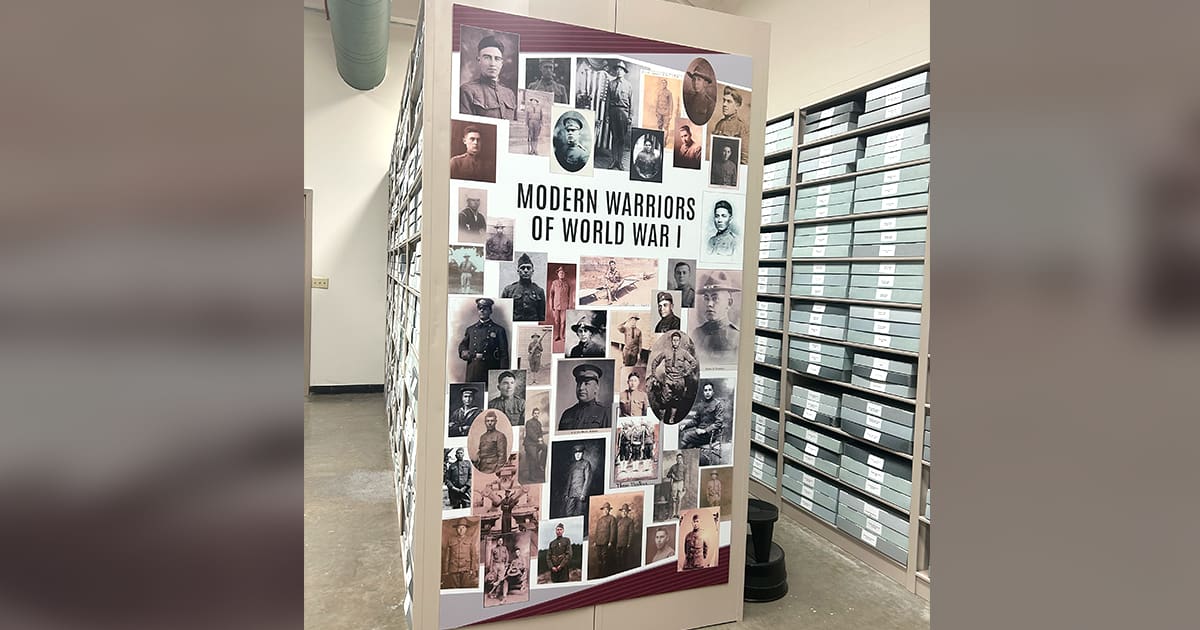
More than 12,000 American Indian and Alaska Native men served in World War I, yet many of their stories have long been scattered or overlooked. Now, the University of Arkansas at Little Rock is leading a national effort to restore them to the historical record.
Through its Modern Warriors of World War I project, the Sequoyah National Research Center is the first institution to undertake the task of identifying and documenting all Native service members who served during the war. What began in 2017 as part of the centennial commemoration of America’s entry into World War I has grown into a groundbreaking national archive.
“When we began Modern Warriors of World War I in 2017, no one else had ever attempted to identify all 12,000 American Indians and Alaska Natives who served in the war,” said Erin Fehr, assistant director and archivist of the Sequoyah National Research Center. “We are striving to preserve their stories and share them with their descendants, tribes, and scholars around the world.”
The scope of the work places UA Little Rock at the center of a national conversation about Indigenous military service and historical recognition. While Native Code Talkers are widely known, far less scholarship has explored the individual contributions of the thousands of Indigenous men who served in infantry units, naval operations, aviation, medical corps, and other roles during World War I.
“There is very little scholarship about the individual contributions of Native American service members from WWI,” Fehr said. “We want to ensure that all service is recognized and remembered, regardless if they served for only one day or for the entire war.”
About one-third of those Native men were not U.S. citizens at the time they enlisted or were drafted. Citizenship would not be extended to all Native Americans until the Indian Citizenship Act of 1924 — legislation influenced in part by Native military service during the war.
“They served not just for the United States,” Fehr said, “but they served to protect their families and homelands.”
UA Little Rock’s leadership in this work is built on decades of research and relationship-building. The Sequoyah National Research Center is home to the world’s largest collection of Native American newspapers and periodicals, a distinction that provides a unique foundation for identifying veterans and understanding how their communities honor their service.
The center’s longstanding partnerships with tribal nations have been central to the project’s success. The Choctaw Nation of Oklahoma collaborated with researchers to document more than 300 of its WWI veterans. The Comanche Nation and the Nez Perce Tribe have also worked alongside the center to ensure their veterans are represented accurately. Families of veterans have contributed photographs, letters, and personal records — strengthening the archive through community engagement.
“We have built relationships with various tribes and their cultural institutions, which allows us to collaborate in order to gather this information for our new website,” Fehr said.
The project’s impact extends beyond documentation. In partnership with the World War One Valor Medals Review Task Force at the George S. Robb Centre for the Study of the Great War, the Sequoyah National Research Center has helped identify 25 Native veterans eligible for review for a possible Medal of Honor. In 2018, Congress mandated a systematic review of minority World War I service members who may have been overlooked for the nation’s highest military honor due to race. Final determinations will be made by the Department of Defense.
By contributing research to this national review process, UA Little Rock is playing a direct role in addressing historic inequities in military recognition.
At the heart of the initiative is a commitment to humanizing service members whose stories have too often been reduced to statistics.
“Native Americans have been invisible in contemporary scholarship, and historically, when Native Americans are documented, it has been with a clinical approach,” Fehr said. “Modern Warriors of World War I seeks to humanize the individual by focusing on their personal experiences as seen through personal letters, photographs, and more. While their service was over one hundred years ago, they deserve to be remembered as more than just a number.”
The forthcoming Modern Warriors of World War I website, expected to launch this summer, will serve as a central national repository featuring individual profiles, military records, letters, and photographs gathered from institutions across the country, including the National Archives and Records Administration and numerous state archives and historical societies.
“To our knowledge, this will be the only website of its kind,” Fehr said. “This unique resource will expand scholarship, commemorate service, and celebrate Native American stories by providing access to primary resources.”
The work also carries local resonance. During World War I, Camp Pike — now Camp Joseph T. Robinson — served as a major training center near Little Rock for soldiers from Arkansas and Oklahoma, including Native service members. That connection underscores how UA Little Rock’s leadership in preserving Indigenous military history is rooted both in regional history and national impact.
With approximately half of the estimated 12,000 Native service members identified so far, the project continues to grow. As new names are uncovered and additional records are shared, UA Little Rock remains at the forefront of ensuring these veterans are recognized as an integral part of American history.
Through research, partnership, and digital innovation, the Sequoyah National Research Center is not simply preserving the past — it is leading the nation in redefining how it is remembered.To learn more about the Sequoyah National Research Center, visit ualr.edu/sequoyah/.