
UA Little Rock Launches CORE Center to Advance Cybersecurity Research and Workforce Training
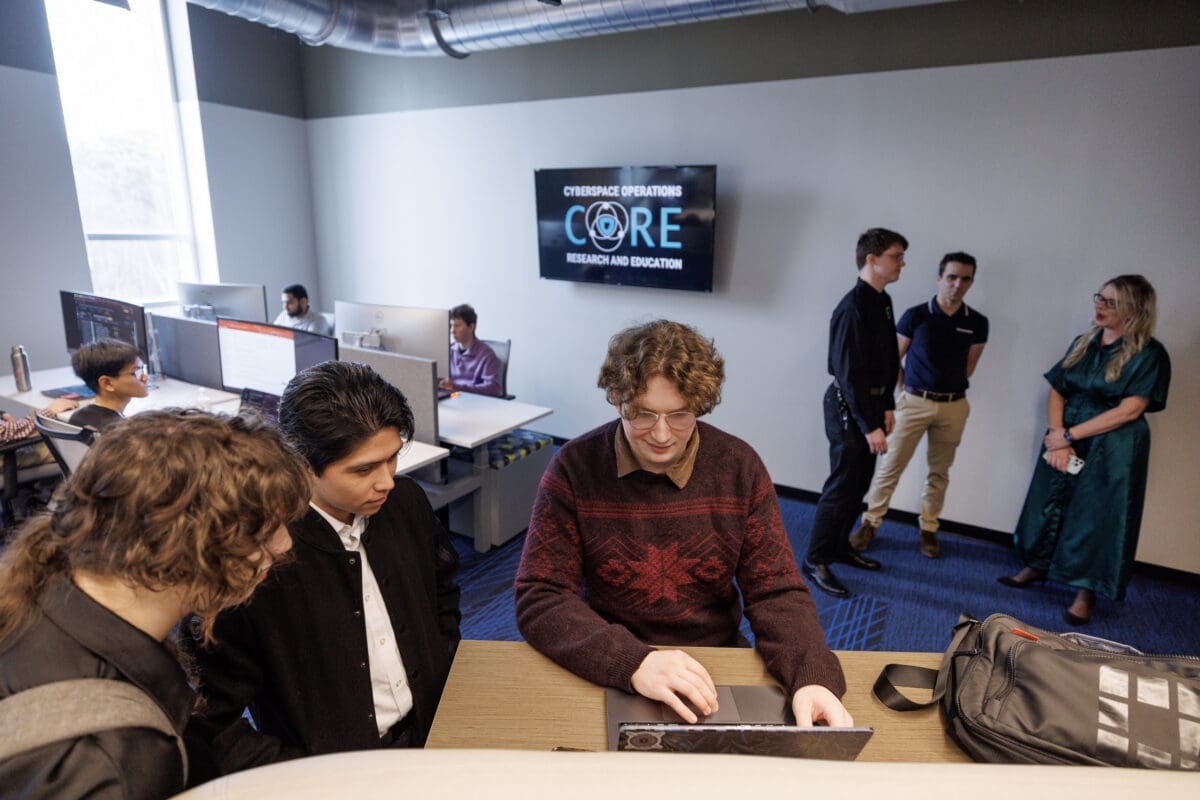
As cyber threats continue to grow across industries, the University of Arkansas at Little Rock is expanding its role in cybersecurity research and workforce development with the launch of the Cyberspace Operations, Research, and Education (CORE) Center, a multidisciplinary hub designed to connect research, education, and real-world operations.
The recently opened CORE Center, established through a $1 million grant from Arkansas Attorney General Tim Griffin, provides students and faculty with advanced lab space, immersive training, and opportunities to collaborate with government, military, and industry partners.
Dr. Philip Huff, director of the CORE Center and associate professor of computer science, said the facility blends cybersecurity and artificial intelligence with research and education to combat growing cyber threats.
The facility includes several specialized spaces that support the center’s mission, including classrooms, research labs, secure computing environments, and a cybersecurity clinic where students gain hands-on experience protecting organizations from cyber threats.
The center also features a secure digital forensics space designed to meet law enforcement standards for handling sensitive data. The room operates in a controlled environment with isolated computing systems and strict access controls, allowing researchers and investigators to analyze digital evidence without external network connections.
Faculty and students are working with partners such as the FBI, the Arkansas State Police, and the Pulaski County Prosecutor’s Office to explore ways technology can help reduce investigative backlogs and improve digital forensic analysis.
One of the center’s key components is the cybersecurity clinic, a working space where students provide cybersecurity assessments and support for organizations that may not have the resources to hire professional security services.
The clinic partners with public schools, small businesses, healthcare providers, and community organizations across Arkansas to identify vulnerabilities and recommend practical defenses.
“We primarily work with organizations that may be high-level targets but don’t have the resources to protect themselves against cyber threats,” Huff said. “Students help scan their networks, identify weaknesses, and recommend steps they can realistically implement.”
Around 30 students currently participate in the clinic through paid positions or volunteer opportunities. Participants receive mentorship from cybersecurity professionals and gain practical experience that strengthens their resumes and prepares them for the workforce.
“The idea is to blend community needs with student opportunity,” Huff said. “There’s a seemingly infinite amount of cybersecurity work that needs to be done, and this gives students the chance to contribute while they’re still learning.”
In addition to operational training, the CORE Center supports research focused on some of the most pressing cybersecurity challenges facing critical infrastructure and modern technology systems.
Researchers at the center are exploring how artificial intelligence can strengthen cyber defense systems. Using reinforcement learning models, faculty and students create simulations that allow cyberattacks and defensive responses to occur simultaneously. By studying how those interactions play out, researchers can better understand how threats evolve and identify strategies organizations can use to strengthen their defenses.
The center is also expanding its work into emerging areas such as cybersecurity for commercial satellites. Because satellites operate in remote environments where physical maintenance is impossible, researchers are exploring autonomous cybersecurity systems capable of detecting and responding to threats in real time.
“We’re focused on critical infrastructure as well,” Huff said. “An attack on systems such as power systems and water systems can have immediate physical consequences for communities. Our work identifies stronger, more effective ways to make these systems resilient and better prepared to withstand and recover from cyber threats.”
By combining research, hands-on training, and partnerships with government and industry, the center gives students opportunities to apply their knowledge to real-world challenges while contributing to the security of critical systems.
“These are rapidly evolving fields,” Huff said. “The CORE Center is unique not only in advancing innovation to secure our digital future, but also in developing new educational programs that prepare our workforce for future challenges.”
Through these efforts, the CORE Center positions UA Little Rock as a key contributor to cybersecurity, digital forensics, and AI innovation in Arkansas and beyond, helping build the talent and technology needed to protect critical infrastructure and support the state’s growing technology economy.