
UA Little Rock Student turns Personal Experience into Award-Winning Research
There is a photograph Peter Zokoro returns to in his research presentations: two children hunched over their schoolwork late at night, their only light a flickering kerosene lamp. He does not use it for dramatic effect. He uses it because he has lived it.
Zokoro, a master’s student in mechanical engineering at the University of Arkansas at Little Rock, grew up in Nigeria, where electricity is not a given. That experience became the foundation of his research, research that recently earned him first place at one of the largest engineering conventions in the country.
“You feel the impact of energy in its absence,” Zokoro said. “Not in its abundance. In its absence.”
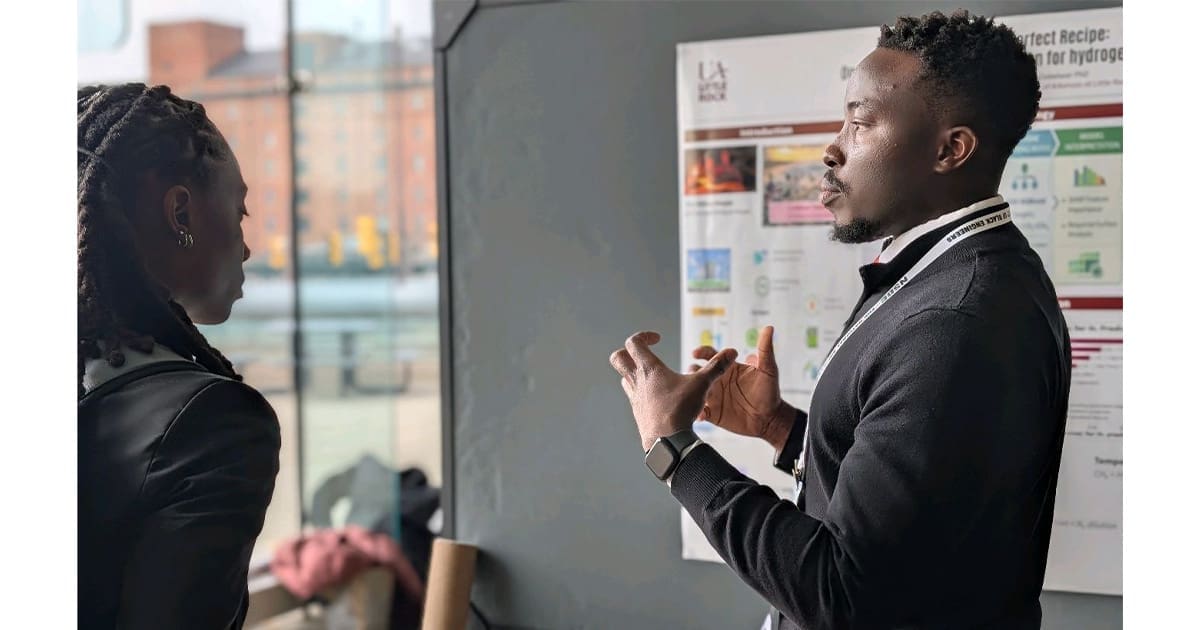
In April, Zokoro won first place in the Technical Research Exhibition at the 2026 National Society of Black Engineers Annual Convention in Baltimore, competing in both poster and oral presentation categories against students from universities across the nation.
His research focuses on biomass gasification, a thermochemical process that converts waste materials into syngas. Syngas can then be utilized to generate energy, produce green hydrogen and support chemical synthesis. The approach addresses two global challenges at once: the approximately 750 million people worldwide who lack access to electricity, and the roughly 2 billion tons of solid waste generated annually.
He earned his undergraduate degree in mechanical engineering from Lagos State University in Nigeria, graduating top of his class with First Class Honors. He moved to the United States in 2024 to pursue his master’s degree, hearing from a friend back home how supportive UA Little Rock faculty are, his choice was made. He quickly immersed himself in campus life while exploring his academic path, earning a graduate teaching assistantship early on to cover expenses. He also joined the American Society of Mechanical Engineers (ASME) and the campus chapter of the National Society of Black Engineers (NSBE), where he now serves as treasurer and international chair, helping build mentorship pipelines and organize professional development opportunities.
During this time, he found his research focus through Dr. Ashokkumar Sharma, his thesis advisor. Sharma’s work centered on two challenges that were deeply personal to Zokoro, challenges he had lived – access to energy and the growing problem of global waste – prompting him to take action. As his learning and research progressed, he began building a research team, recruiting undergraduate students and introducing them to his vision, inviting them to contribute to the project.
“Peter Zokoro is one of the most driven graduate students I have mentored,” said Sharma. “His innovative bioenergy and machine learning research, along with his leadership and mentorship of undergraduates, reflects both depth and originality. His first-place award at the 2026 NSBE Conference reflects his academic and community impact.”
In Baltimore, Zokoro arrived with the research to match his ambitions. Supported by Dr. David Montague, NSBE chapter co-advisor, and other UA Little Rock students in attendance, he earned first place. Their presence made the achievement all the more meaningful.
“Seeing familiar faces from UA Little Rock in that room while I was presenting meant more than I can put into words,” Zokoro said. “UA Little Rock may not be the biggest school in the room, but we showed up and we won—that matters for every student here.”
The pride he felt was shared by others within the UA Little Rock community, including his mentors.
“Zokoro exemplifies the hard work and dedication of UA Little Rock students. His innovative research resonated with audiences, and his award for best presentation came as no surprise,” said Montague.
Zokoro graduates this May, but the vision behind his research continues to expand — shaped by his lived experiences and the support he found at UA Little Rock. He hopes to help build a future where clean energy is accessible everywhere and give new purpose to materials often thrown away.
“For developed nations like the U.S., the vision is energy independence,” Zokoro said. “Reducing and eventually eliminating dependence on fossil fuels by generating clean energy from the waste we already produce. And beyond that, imagine being able to export the green hydrogen generated from this process to other countries and companies that need it. That is a completely new value chain—new economic opportunities built on something we currently throw away.”
For Zokoro, the photograph of two children studying by kerosene light is not just a presentation slide; it is the reason behind his work.