
UA Little Rock Recognized Nationally for Innovative Gifted Education Program
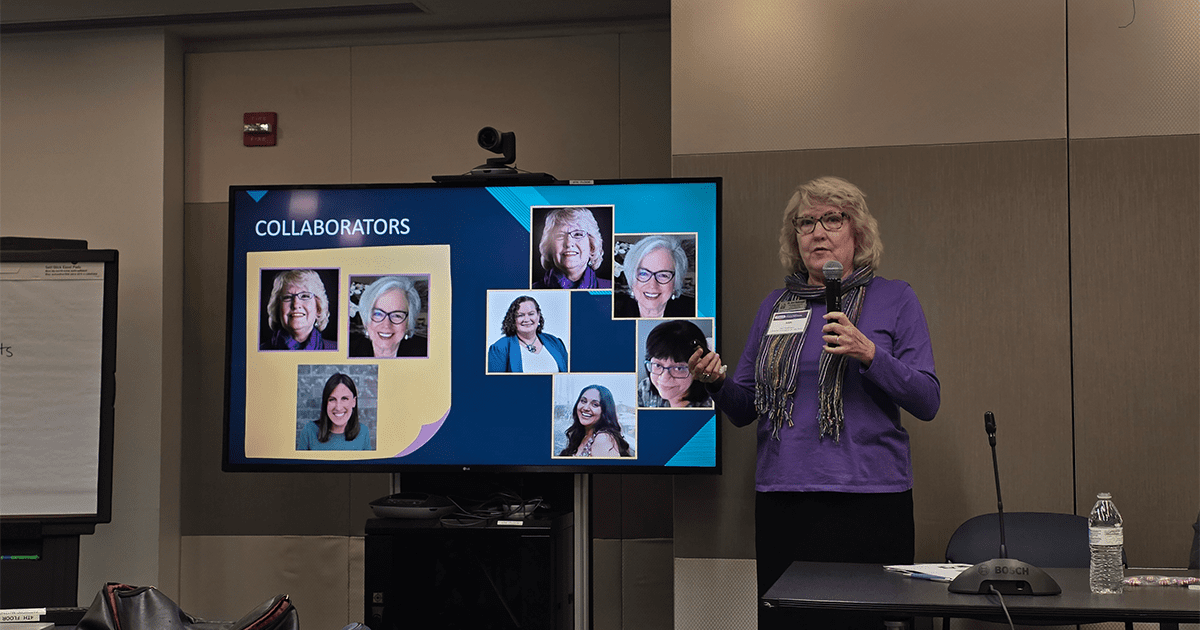
When national leaders in education gathered to discuss how teachers could better support advanced learners, the University of Arkansas at Little Rock stood out as a national model.
Drs. Ann Robinson and Monica Meadows of the UA Little Rock School of Education recently traveled to Washington, D.C., to present at an invitational colloquium organized by the National Association for Gifted Children (NAGC) conference and hosted by the American Federation of Teachers (AFT). As a national leader in research, professional learning, and advocacy for gifted and talented students, the NAGC partnered with the AFT — the nation’s second-largest teachers’ union, representing more than 1.7 million members — to bring together experts and educators dedicated to advancing opportunities for all students.
The Invitational Colloquium, Filling the Gap: Universal Educator Preparation in Gifted Education, brought together educators, researchers, and policy leaders from across the country to address the increasing need for teacher preparation programs that enable educators to recognize and support gifted, creative, and talented students in today’s classrooms.
“Every child deserves to learn something new every day — including advanced and precocious children and youth,” Robinson, director of the Jodie Mahony Center for Gifted Education, said.
During the colloquium, UA Little Rock was recognized as a national leader in gifted education and was invited to present its work to attendees. The university is one of only two undergraduate teacher preparation programs in the U.S. — alongside Purdue University — that requires a course in gifted education as part of the middle childhood education curriculum.
“It’s the combination of our faculty’s commitment and collaboration in both middle childhood and gifted education, along with innovative elements like a rigorous, year-long online residency and a required undergraduate course in gifted education, that sets our program apart. This is innovative thinking at its best,” Robinson said.
The course that started the undergraduate gifted education initiative is GATE 40003, “Gifted, Creative, and Talented Education for Classroom Teachers,” developed about five years ago through a collaborative effort led by Dr. Lundon Pinneo, coordinator of the middle childhood education program. The course was created after Arkansas changed its middle school teaching licensure requirements, creating space in the curriculum for additional specialized training.
“I wanted to use that opportunity to better meet both state requirements and, more importantly, the needs of our students,” Pinneo said.
Using feedback from mentor teachers and faculty, Pinneo identified key areas where future educators needed additional support. She reached out to Robinson to adapt graduate-level gifted-education concepts for undergraduate teacher candidates.
“Without collaboration among faculty, the undergraduate course in gifted education at UA Little Rock would never have taken place,” Meadows said.
Since its introduction, the course has become a defining feature of the middle childhood education program, with faculty collaboration playing a critical role in its success.
“We’ve been given an exciting opportunity for our School of Education to take the lead in demonstrating to the rest of the country how important pre-service preparation programs are in filling the gap that can exist between general education and specialized gifted education,” Robinson said.
At the colloquium, organizers focused on the persistent “gap” in educator preparation nationwide: while most teachers receive training to support students with disabilities, far fewer are prepared to recognize and meet the needs of advanced learners. Through their presentations, Robinson and Meadows offered UA Little Rock’s approach as a model for addressing that challenge, demonstrating how gifted education can be integrated into undergraduate teacher preparation programs.
“There was a lot of excitement around the course and the work we shared at the colloquium,” Meadows said. “People wanted to know how we made it happen, how students are responding to it, and how they might implement similar approaches at their own institutions.”
As universities across the country examine how to prepare educators for classrooms with an ever-growing range of needs, the discussion shows the role gifted education can play in helping teachers recognize talent, tailor instruction, and best support students with advanced learning needs.
“Pre-service teachers come to us with a wide range of experiences and abilities, and all students deserve to be both challenged and supported,” Pinneo said. “Our graduates are leaving the program with more tools to support the different learning needs of their future students.”