
New UA Little Rock Downtown Exhibit Examines History of Play
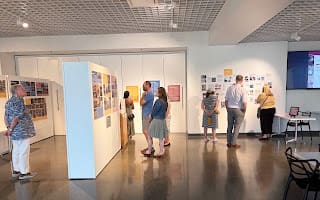
In “The Adventures of Tom Sawyer,” Mark Twain observes (through his protagonist) that “work consists of whatever a body is obliged to do, and that play consists of whatever a body is not obliged to do.” That idea is at the heart of the latest exhibit at University of Arkansas at Little Rock Downtown, which explores the history of play.
“Play in Arkansas” examines how people have created joy through play, and how the history of play can contribute to understanding of both past and present, said Marta Cieslak, director of UA Little Rock Downtown. Research also illustrates both the “immense impact childhood play has on us,” as well as that play is “essential to our well-being — necessary for physical and mental health.”
The exhibit, which opened July 10, remains on display through Dec. 15, and is free and open to the public Monday–Friday from 9 a.m. to 4 p.m. To schedule an individual or group visit to the exhibit, at 333 President Clinton Avenue, email [email protected].
“It’s great that this is available — I love it — I’ll be bringing some folks down here” to see this exhibit while it’s on display, said Aaron Rhoades, a native of Central Arkansas who attended the exhibit’s opening night. “There’s something for everyone.”
Rhoades spent 13 years in Myrtle Beach, S.C., but moved back to Central Arkansas last year because he “missed the sense of community,” a sense that was embodied by this exhibit.
“I really appreciate this type of local history,” he said.
The memories section of the exhibit, where individuals were invited to share their personal reflections on childhood play, is a favorite of Cieslak’s, as it demonstrates how “the community collaborates with us, and contributes to what we do at the university,” she said. “We work across disciplines to connect with the community,” and community members could also loan toys for the exhibit in addition to sharing their childhood play memories for the display, gestures that both require “a lot of trust.”
Nader Afsordeh, who says Star Trek has “always had a special place in his heart,” contributed some of his childhood toys to the exhibit. On opening night, he explained he wanted to see them displayed alongside the rest of the exhibition.
“It’s interesting, the history of play, and it’s really cool to see” the cross-section of toys, along with their context and explanations, he said. “The older toys are very different than toys today — it was a very different world — I’ve enjoyed” the exhibit.
Americans actually preferred handmade toys over mass-produced items until the second half of the 20th century, and “Play in Arkansas” has myriad examples of the former, including a pair of “handmade mountain dolls” from Arkansas, and even a handmade checkerboard from the Spencer Polk family that dates to the 1800s, said Cieslak, a historian and history professor. Another section of the exhibit, “Play in the Time of Hardship,” spotlights how toys aided individuals through trying circumstances, such as the handmade wooden snake crafted by a Russian prisoner of war in France during World War I.
UA Little Rock Downtown collaborated with several partners on this exhibit, including: Arkansas State Archives (Julienne Crawford and Dr. David Ware), Central Arkansas Library System (CALS) Butler Center for Arkansas Studies (Danielle Afsrodeh and Brian Robertson), Old State House Museum (Samantha Ashley and Lark Buckingham), and the UA Little Rock Center for Arkansas History and Culture (Emily Summers Yarberry and Dr. Jess Porter), Cieslak said. “Although loaning items across institutions is a fairly standard practice, let me stress that we never take it for granted, (as) it does require a substantial amount of work from the loaning curators and teams,” but all four organizations “are absolutely terrific to work with.”
Carlie Cowgill, programming and administrative assistant at UA Little Rock Downtown — and a graduate of UA Little Rock’s Master of Arts Public History program — is the exhibit’s co-author, participating in every stage of this exhibit’s development, Cieslak noted. Additionally, Stacey Griggs Matchett, a summer intern for UA Little Rock Downtown, was also involved in researching and developing labels for a section of the exhibit.
Cieslak has heard from several individuals who have explored the exhibit, then experienced memories of their own childhood play rush back to their minds, which “makes this all worth it,” she said. “Hearing that brings such a smile to my face.”
Despite closing in the 1940s, McLeod’s Amusement Park — more commonly known as Happy Hollow — remains fresh in the memories of many Arkansans who have visited “Play in Arkansas,” which highlights the attraction along with other “Arkansas Classics” in Hot Springs, such as Oaklawn Park, the city’s historic bathhouses, an alligator farm, and an ostrich farm, as well as non-Hot Springs sites like Eureka Springs and Crater of Diamonds State Park, she said. “I learned so much about Happy Hollow through this process, and it’s one of the classics in Arkansas.”
Located in the historic River Market District, UA Little Rock Downtown is where university students, faculty, and staff meet with the public to discuss, exchange, and implement ideas that aim to make the world a more just and equitable place for all. It serves as a hub of learning, service, and collaborations across the lines of scholarly disciplines, fields of community activism, and individual backgrounds.
Following “Play in Arkansas” will be an exhibit — scheduled to debut in February 2027 — highlighting the history of UA Little Rock, as it celebrates its centennial year in 2026-27.
“We’re very excited to be part of the Centennial festivities and celebrate 100 years of UA Little Rock,” said Cieslak.