
UA Little Rock Students Improve Campus Observatory with Senior Project
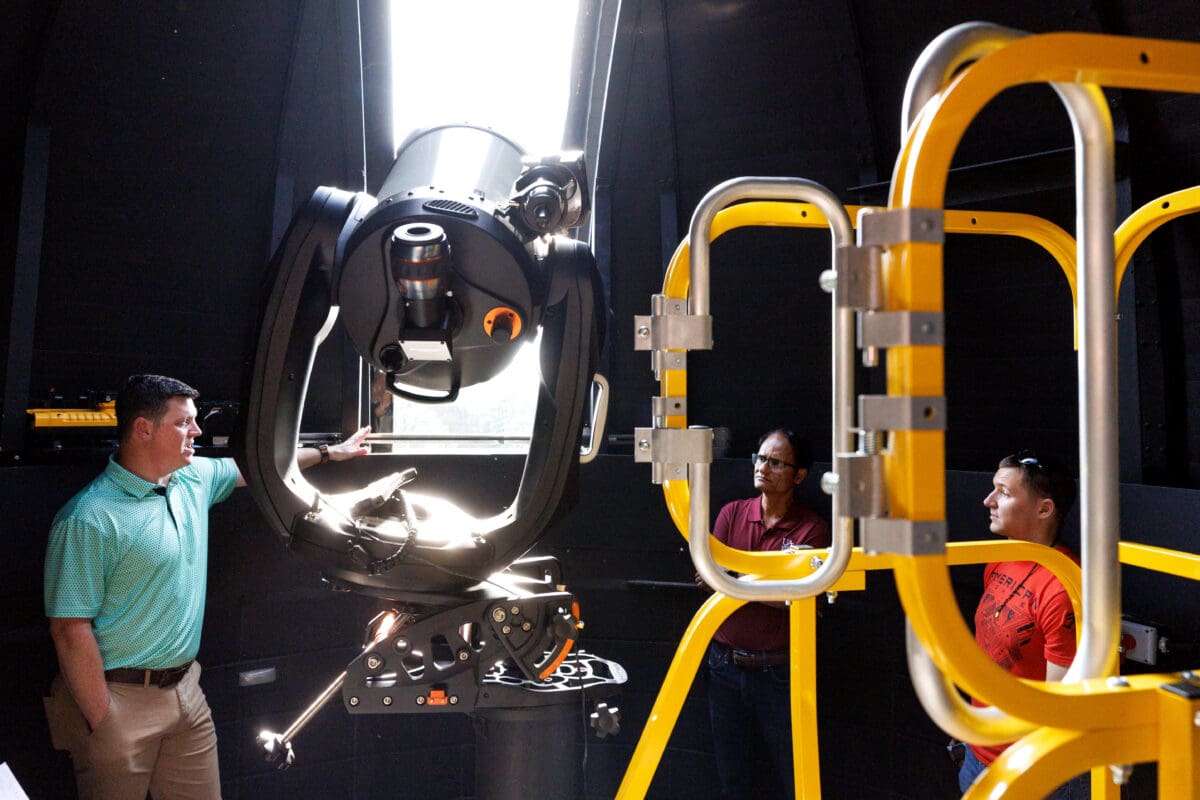
For their Mechanical Engineering Technology (MET) capstone design project, a pair of University of Arkansas at Little Rock students decided to give back to the university in a practical and lasting way: making it easier and more efficient to open and close the shutter for the campus observatory.
On July 23, Jerry Adcock and Andrew Harris demonstrated their handiwork before passing the baton to Gregory Guisbiers, an associate professor of physics and astronomy in the School of Physical Sciences.
“That’s nice, I really appreciate it,” Guisbiers said with a smile as he tried the button for the first time. “Thank you.”
Guisbiers, whose research focuses primarily on nanotechnology, wanted a button, not a handcrank, to open and close the dome’s shutter, but the observatory was built in 1930, which limited the options for Harris and Adcock.
Fortunately, while discussing the project, Adcock’s father, Tony — who has worked in the aviation industry for more than four decades — mentioned he had an extra garage door opener kit, which “sparked the whole thing for us,” Adcock said.
They installed a 20-volt battery inverter for power to plug in the garage door opener without modifying wiring, and “there was a lot of fabrication on our end, but we were able to follow through on our vision, which was very satisfying,” Adcock said. “It feels really good, (because) this is not something that’s going to be thrown in a closet and forgotten about — people will use it.”
Indeed, “the primary reason to do this was that it would be useful and have an end-user,” said Harris, who also worked in the engineering/engineering technology office during his senior year on campus. “This isn’t going to get thrown away.”
In some ways, the challenges — but ultimate reward — of this final project mirrored Adcock’s overall experience earning his engineering degree, he said. “I wanted to make a mark with my senior project — I just never knew it would be this — but it (became) a spot I could use everything I’d” learned in school and the workforce.
He and Harris began their work in earnest roughly eight months ago, as the method for opening and closing the shutter was “showing its age” and not user-friendly, he said. There were also safety concerns, as the crank handle actually stuck out into the observatory space.
“Project Stargate” crucially removed that problematic handle, and he and Harris were able to “divide and conquer” on the project, Adcock said. Harris was “logistics on the ground” on campus and did a massive amount of 3D printing, for example, while Adcock was able to share some of his acquired wisdom with his younger partner, a learning experience for them both.
“It’s fun — we really did enjoy it — the outcome was worth it,” added Adcock. “I love old structures, so I didn’t want (any) changes to stick out, (and everything) blends well.”
Harris is similarly gracious to Adcock, noting “Jerry has industry experience, and this would not have been possible without his fabrication skills.”
Both students “invested an extraordinary amount of time and effort to bring this project to a successful completion, (as) their work went well beyond the scope of a conventional senior capstone project,” said Professor Srikanth Pidugu, Yupo Chan Director of School of Engineering & Engineering Technology. “For most senior design projects, the primary objective is to design, build, and demonstrate a functional prototype, (but) Jerry and Andrew developed a system that is much closer to a market-ready product, one that has the potential to be commercialized and deployed in a real-world setting.”
“Developing a product intended for practical use requires a much higher standard than building a prototype,” requiring “not only that the system functions as intended, but also that it is reliable, robust, user friendly, and capable of meeting the expectations of its end users,” added Pidugu. “Throughout the project, Jerry and Andrew remained committed to achieving these standards. They continually refined the design, overcame technical challenges, conducted extensive testing, and worked diligently to deliver a solution that the client could confidently use.”
They knew “this was not your ‘normal project’ (which made it) pretty special, but also obviously (added) some pressure,” Adcock said. “We really followed through” on everything from safety to maintenance plans — “we didn’t want to leave anything open-ended — we felt this was more than just a project, and it felt good to succeed.”
Adcock even designed a 3D-printed plate, then made it look like aged bronze, to be mounted on the equipment plate, and made copies for Harris and Pidugu, which he presented them July 23.
“I cannot be thankful enough to both of them — and to Dr. Pidugu (for allowing) them to work on this project — it was really needed,” Guisbiers said. “The observatory has now a fully electric dome rotation and dome opening which make it easier to operate and looks much more professional than the old system.”
Adcock had long dreamed of attaining his engineering degree, but balances schoolwork with a full-time job and his family — he and his wife of 18 years, Andrea, a teacher, have two daughters, 14 and 10 — and the university “made it work for me,” no matter his scheduling challenges.
It’s “been a long road of mental and emotional hurdles, (but) I can’t imagine not having this (educational) experience (at UA Little Rock, because) it’s helped me be more prepared and professional,” said Adcock, who has one more class to complete this fall before graduating in December. “I’ve been able to help other people, too, which I really enjoy.”
Transferring from Arkansas State University to UA Little Rock was “one of the best decisions I’ve ever made,” said Harris, who is continuing his education through the Missouri University of Science and Technology’s online program. Especially during this project, UA Little Rock professors “were very invested and helpful.”
The observatory dome project helped Harris secure a summer internship with the Little Rock Water Reclamation Authority, an experience that reinforced his goal of working in public engineering.
The Jonesboro native hopes to design infrastructure for utilities or government that will “impact a large amount of people,” he said. “I want to be useful and see the physical impact of what I’m doing.“
The willingness of Adcock and Harris “to go far beyond what is typically expected of a senior capstone project reflects their character, work ethic, and commitment to engineering excellence,” noted Pidugu. “They have represented the School of Engineering and Engineering Technology with distinction, and they should be commended for this remarkable accomplishment and for delivering a product that will provide lasting value to its users.”
After several years of inactivity, the observatory located atop Stabler Hall was renovated and reopened in March 2025, due in part to the overwhelming enthusiasm sparked by the university’s public event for the Great North American Eclipse the previous April. Guisbiers now holds several observations there annually, offering both daytime and nighttime events.
The next scheduled event is the partial lunar eclipse August 27, but no more than 25 people are permitted on the roof at the same time. Those interested in attending can find more information on the observatory website.