
New Natural History Museum at UA Little Rock will be Scientific Outreach to Community
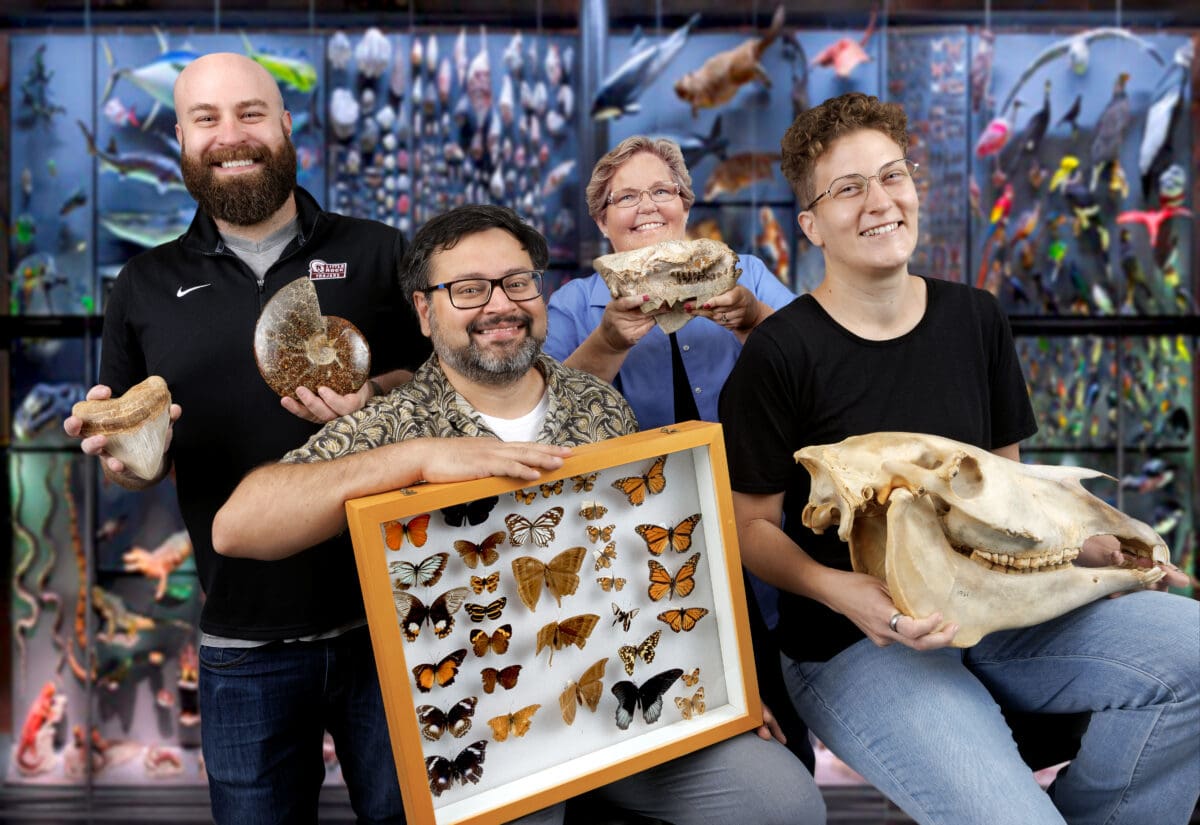
The University of Arkansas at Little Rock’s planned Museum of Natural History will feature “so many really amazing items from our collection, bring more people to campus, (and accomplish) scientific outreach” through its myriad displays, according to Dr. Sinéad Ní Chadhain, associate professor and chair of the biology department.
“Our hope is to engage people — curious about the world around them — in science,” said Ní Chadhain, who is leading the effort to bring university collections together to form the museum. There are myriad “cool” items in the university’s collections, but they’ve mainly been used for classes — not open to public view — and “we need to share with the public, (because) we are a public institution.”
The museum, which will be located on the fifth floor of Ottenheimer Library, will be one leg of the university’s Science Triangle, a connected series of experiences designed to make STEM learning more accessible and engaging for students and the broader community. The triangle also includes the campus observatory and Shellam Flake Planetarium, slated to reopen in a limited capacity later this year.
The museum “is much more than a place to display collections; it is a cornerstone of our vision to transform UA Little Rock’s campus into one of (the state’s) premier destinations for STEM education, discovery, and public engagement,” noted Dr. Tansel Karabacak, professor and dean of the Donaghey College of Science, Technology, Engineering, and Mathematics. The Science Triangle will be “a unique learning ecosystem where students, researchers, educators, and families can explore everything from Earth’s biodiversity to the farthest reaches of the universe.”
“What excites me most is the opportunity to inspire curiosity and lifelong learning while creating new possibilities for interdisciplinary research, experiential education, and community partnerships,” added Karabacak. “The Science Triangle will not only enrich the educational experience of our students, but will also become a regional resource that welcomes thousands of visitors each year and showcases UA Little Rock as a leader in science education and innovation.”
The Museum of Natural History will utilize myriad artifacts, minerals, and specimens to demonstrate the timeline of Arkansas, from when the state was literally underwater, to the present day, said Ní Chadhain. Interactive exhibits and educational experiences will connect students, school groups, and community members to the state’s history through the museum.
“Arkansas hasn’t always looked the way it looks now — there was a time it was under a shallow sea, and the animals that lived here then are still here in the rock as fossils — we can’t make sense of where we are at now without knowing what came before, and fossils are the only record we have of that life and those changing environmental conditions,” said Dr. René Shroat-Lewis, associate professor in the geology department. “For a lot of people, their first real encounter with science doesn’t happen in a classroom, it happens in a museum, and we can be that first encounter here at UA Little Rock.”
The goal is to have the museum ready for certain small groups of visitors by the end of this calendar year, with hopes to open widely to the public in spring 2027, said Ní Chadhain. “Our biggest effort so far has been getting our collections organized and catalogued,” as the biology department alone has more than 15,000 specimens.
“Most of our specimens are from Arkansas — really local — which makes our collection unique,” and specimens date back several decades, so researchers can track how species have evolved, said Dr. Raffaela Lesch, assistant professor of biology. For example, “we can study how populations” — such as raccoons — have “adapted as Little Rock became more urbanized.”
“It’ll be so exciting to have the new museum space,” not only for displays, but storage, as “we can add more” specimens, said Lesch. As work continues, researchers from around the world will be able to collaborate with UA Little Rock to advance scientific knowledge and understanding, but the museum will also help preserve the collection for future researchers.
Collections like these are “research material, and we hold them in trust,” keeping them available for those who wish to study them, said Shroat-Lewis. “Plus – and I think this is incredibly important” – museums are cradles of learning, where “it’s fine to not know something and ask questions.”
Lesch and others in her department are already advancing research with technology that can — for example — create detailed 3D renderings of various animal skulls in the collection for study, she said. The aim is making specimens in the collection “untouchable by time.”
The university’s “fantastic collection” of insects will also be featured in the museum, as well as rocks, minerals, and meteorites, plus various fossils, said Ní Chadhain. Additionally, “you’ll actually be able to see into the working museum space through glass” when touring the museum.
Fossils are where the story truly begins, “the first evidence we have of how life responds to a planet that keeps changing,” said Shroat-Lewis. While youth can view images of fossils in books, nothing compares with “standing in front of one and understanding it was an organism that was alive,” an opportunity they’ll have at the museum.
Many items in the collection have been collected by UA Little Rock students, past and present, including Dr. Ian Clifton, now an assistant professor in the biology department who collected several specimens while an undergraduate at UA Little Rock from 2009-2013, a time when he fell in love with biology and research.
“As part of my Vertebrate Zoology and Mammalogy classes, we were required to collect specimens and prepare them for the museum — there were opportunities to capture some of the specimens during field trips and labs, but a lot of the work happened outside of class — it took a lot of time and effort because it meant we had to apply what we had been learning in class to identify the best locations and habitats for the animals,” said Clifton. “It was challenging work, but I came out of the classes with a deeper understanding of the animals I was working with, and it was the class that solidified my aspirations of going into research.”
“Not only did I learn a ton about animals and practical skills, but I met some amazing people I’m still friends with today,” added Clifton. “I think this is a really unique aspect of field courses: you learn to work with people in different and challenging contexts, and that can be really effective for building lasting bonds.”
Returning to his undergraduate institution was a “homecoming” for Clifton, and he appreciates the new perspective on UA Little Rock’s scientific work he has now as an educator compared with his student days.
“We had discussions in class about the value of natural history collections, but at the time I don’t think I really appreciated how important natural history collections are as a scientific resource,” he said. “I’m glad now that I had the opportunity to contribute specimens that will inspire future generations of scientists and that those specimens may be used in the future to explore new scientific questions and provide new insight into how the natural world functions.”
The museum was “developed out of the research endeavor,” as several science faculty have been working on a grant proposal to the National Science Foundation, and it became evident that sharing the university’s collection with the public could help advance science education in Arkansas, said Ní Chadhain. “We want our work on campus to be accessible and relevant to the public” — especially since Arkansas is “The Natural State” — and “it’s important for public institutions to communicate with the public.”
So many Arkansans “feel a deep connection to nature and wildlife, and I think a lot of people will be just as excited to explore our collections as I am” through the new museum, said Clifton. “UA Little Rock has something truly unique” with its collections, and the museum “is an excellent way for UA Little Rock to showcase these collections and engage our community in new ways.”
Creating the Museum of Natural History is an example of why Ní Chadhain joined UA Little Rock in 2025 after nearly two decades at the University of South Alabama.
UA Little Rock is “on the upswing” and provides a culture open to — and supportive of — big ideas, she said. “It’s a ‘Why not’ mindset — ‘why wouldn’t we try this’?”