
A Student Leader With a Global Perspective: How One UA Little Rock Graduate Inspired Change on Campus and Beyond
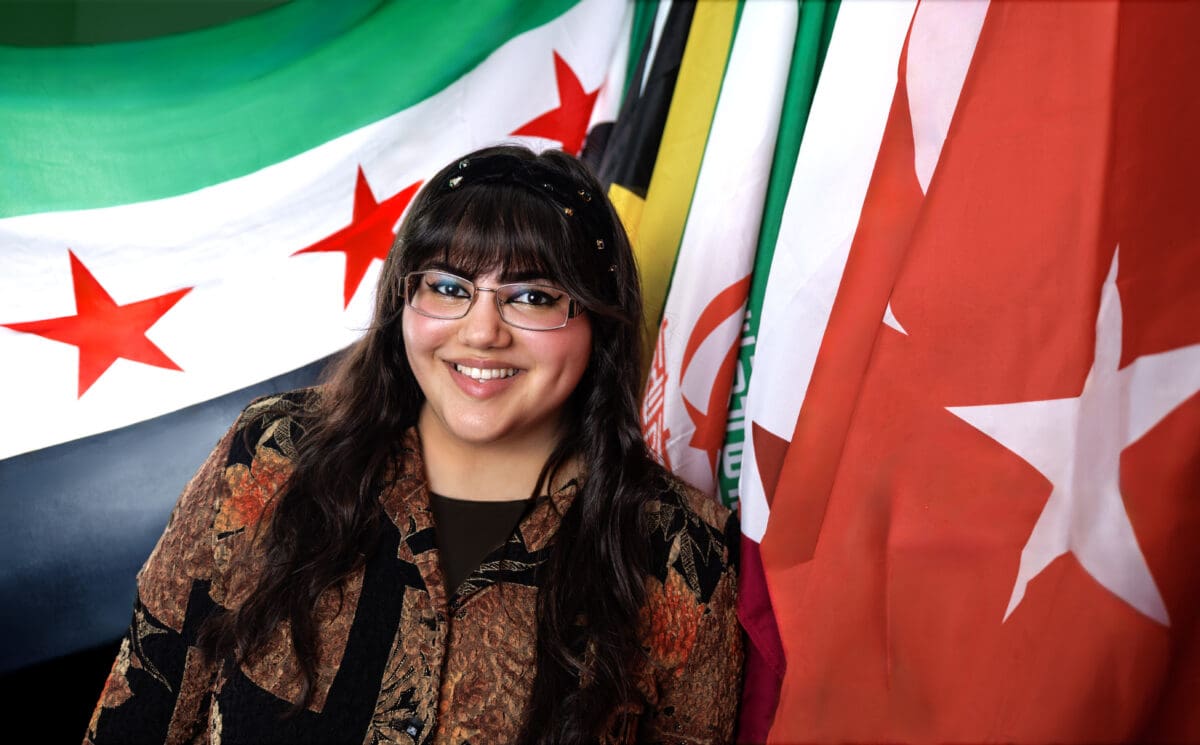
For Dalia Daaboul, her University of Arkansas at Little Rock education was never just about earning a degree, but using knowledge to better understand the world and finding meaningful ways to make a difference.
Throughout her time at UA Little Rock, Daaboul paired academic excellence with campus leadership and community service, mentoring fellow students while raising thousands of dollars to support humanitarian efforts for Syrian refugees.
Now, after graduating from UA Little Rock this spring with bachelor’s degrees in political science and philosophy, along with a minor in Middle Eastern studies, she is taking a gap year to study for the Law School Admission Test (LSAT), apply to law school, and work toward publishing her honors thesis.
Her academic journey was shaped by the Donaghey Scholars Honors Program, whose scholarship and mentorship opportunities drew her to UA Little Rock.
“My acceptance to the program pushed me to come here,” Daaboul said. “It fully covers tuition and provides so many wonderful opportunities, like building close relationships with professors and studying abroad.”
While Daaboul excelled academically, she believed meaningful change also happened beyond the classroom. Through her leadership roles, she connected people, organized service projects, and left a lasting impact on the community.
She served as president of the Young Democrats at UA Little Rock, co-president of the Socratic Society, secretary of the Ethics Bowl team, Middle Eastern Studies student representative, and founder and president of the university’s chapter of the Syrian Emergency Task Force. Through these organizations, she organized educational events, connected students with community leaders, and created opportunities for dialogue across disciplines.
Her work with the Syrian Emergency Task Force, which she founded on campus her freshman year, became one of the most meaningful aspects of her college career. By organizing volunteer-driven thrift sales, she and fellow students raised thousands of dollars to support educational initiatives and humanitarian assistance for Syrian women and children.
These fundraising events, funded by the Middle Eastern studies committee, were entirely student-led and driven. Daaboul utilized forms posted on social media to recruit volunteers as well as donations. UA Little Rock students donated everything from clothing items, to vinyl records, to handmade jewelry to sell at these thrift drive events.
“I think people sometimes feel like things happening around the world are so far away that they can’t make a difference,” Daaboul said. “But every little bit counts. If you can improve one person’s life, that’s worth something.”
The same curiosity and desire to better understand complex issues also shaped Daaboul’s academic work. Her honors thesis reflected the interdisciplinary approach that defined her education at UA Little Rock. Drawing on political science, philosophy, history, and anthropology, she analyzed texts in English, Arabic, and Turkish. Her research explored how the modern Turkish feminist movement has developed amid competing political, religious, and cultural influences, arguing that Turkish women have resisted limiting narratives by asserting their own agency, autonomy, and choice.
Rather than challenging previous scholarship outright, Daaboul said her goal was to identify the perspectives that had been overlooked.
“We’re not really throwing things away,” she said. “We’re looking at what’s missing.”
The project was shaped by mentors from several academic disciplines, whose perspectives helped her build a more nuanced understanding of the subject, but her own lived experience as a Syrian American was just as important.
Among the faculty who shaped her academic journey, Associate Professor and Philosophy Program Coordinator Dr. Jana McAuliffe played a particularly influential role. McAuliffe taught Daaboul in five courses and two independent studies and directed her Donaghey Scholars capstone project.
McAuliffe described Daaboul’s scholarship as unusually advanced for an undergraduate, particularly given the ambitious, interdisciplinary nature of her thesis. Daaboul had to develop an argument that satisfied the standards of three academic disciplines while thinking through two distinct cultural perspectives.
“In the end, her thesis was a work that was uniquely her own — it seems like it could not have been written by anyone else,” McAuliffe said. “The creation of such a specific and unique voice within an academic work is quite rare for undergraduates.”
During her sophomore year, Daaboul visited McAuliffe’s office with only one certainty — that she wanted her honors thesis to be grounded in feminism. She wasn’t yet sure what questions she wanted to explore or that the project would eventually become interdisciplinary.
“I just remember her being so encouraging,” Daaboul said of McAuliffe. “That’s such a broad and vast area, but she really helped me narrow down my ideas and helped me actually construct a thesis. It was in that moment, too, that I felt seen and really taken seriously. That meant a lot to me in my academic career.”
McAuliffe said what stood out about Daaboul extended beyond her academic ability. She saw a close connection between Daaboul’s intellectual interests and her commitment to civic engagement.
“I think Dalia is a very serious and complicated thinker who also wants to make positive impacts in the world based on her intellectual commitments,” McAuliffe said. “That is why there are such clear connections between her service and her research, which goes in both directions — her thinking informs the political work, and her political work informs her thinking.”
Daaboul has learned that effective leadership begins with listening and being a good steward of the community.
“I’ve had so many conversations where people tell me they think it’s wonderful that I’m active in trying to make the world a better place, but they just don’t believe the world will ever change,” she said. “Leadership is sitting down with them, not diminishing their concerns, and saying, ‘I understand,’ but if we all think (the world won’t ever change) and take a step back, they’ll be right. Nothing will ever change.”
She hopes her time serving on campus has demonstrated people can always make a difference.
“I think that impact does not just come from the individual, but from the relationships the individual is able to cultivate,” she said. “What I hope is that through my leadership roles and conversations, people feel inspired to go create a movement, to start an organization, and to start something that is meaningful to them on campus.”
As she prepares for law school, Daaboul hopes to continue building bridges between scholarship, public service, and advocacy. She hopes her time at UA Little Rock has encouraged her fellow students to stay active and helped others believe they have the power to make a difference.