
UA Little Rock Summit Convenes Industry Leaders to Discuss Solutions for Workforce Challenges
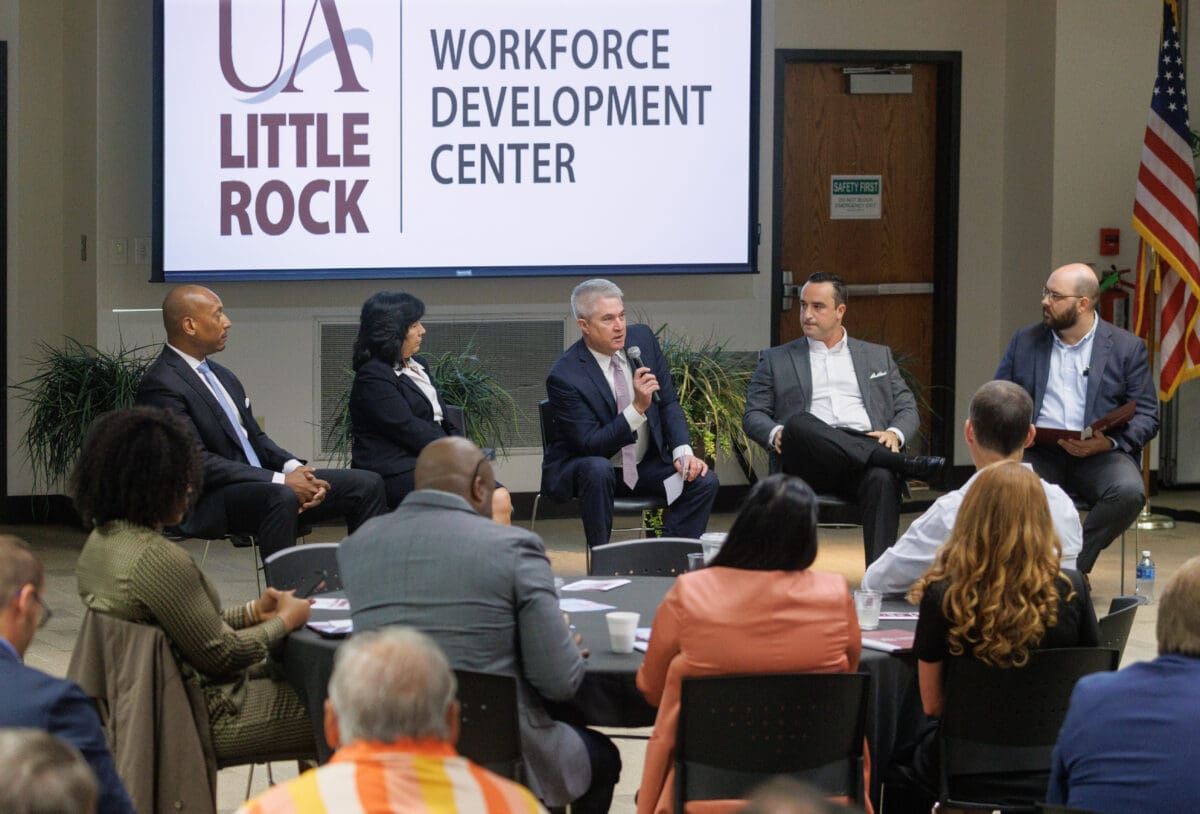
Higher Education institutions like the University of Arkansas at Little Rock — which recently hosted its inaugural Workforce Summit — play a crucial role in workforce development, and that role grows ever more important as technology evolves.
On Thursday, Sept. 24, leaders from education, industry, government, and workforce organizations convened on campus to discuss strengthening partnerships and finding new ways to meet the region’s evolving workforce needs. Panel discussions, student and mentor reflections, presentations, and breakout sessions were among the highlights, and student interns and their mentors shared their experiences with experiential learning, offering a firsthand look at how partnerships between the university and employers can help prepare students for the workforce. Topics for breakout sessions included artificial intelligence, cybersecurity, nursing, social work, early childhood education, business development, and corporate business training.
Preparing individuals for a first job is only one element of the mission for universities; UA Little Rock also creates opportunities for advancement, upskilling, and re-skilling, said UA Little Rock Chancellor Christina S. Drale. Universities like UA Little Rock are engines of economic growth and talent development, not only via traditional degrees, but certificates, skills training, professional education, internships, applied learning, and customized programs developed alongside employers.
“We begin by listening — employers must have a voice” — and feedback from business and industry identify any gaps in education, which can be addressed to meet the needs of an evolving economy, added Drale. “That spirit of collaboration is at the heart of today’s summit.”
Connecting students with employers hiring right now is paramount, and UA Little Rock’s Workforce Development Center “does incredible work” preparing students for careers, Gov. Sarah Sanders noted in a video that helped kick off the summit.
Indeed, the center was designed to impact students not only at the start of their work lives, but throughout their careers, noted Dr. Aaron Duvall, the university’s executive director of workforce development. UA Little Rock and other four-year universities are critical in the second tier of workforce development, assisting students who want to progress in their careers by adapting, evolving, and adding skills while also helping employers tap into resources and expertise.
And programs offered by UA Little Rock all demonstrate strong return on investment for graduates, said Dr. Ken Warden, commissioner of the Arkansas Division of Higher Education. UA Little Rock “is a gem, a tremendous asset to this community.”
Warden was part of a panel discussion moderated by Hunter Field, editor of Arkansas Business, that also included: Jack Thomas, senior vice president of economic development for the Little Rock Regional Chamber; state Rep. Mary Bentley; and Pulaski County Justice of the Peace Steven Person.
“Nationally, it’s a numbers game,” as roughly 8,000 more individuals age out of the American workforce daily than those who age into it, so states and regions must attract individuals from elsewhere to fill various job openings, said Thomas. Without an adequate local workforce, areas risk “economic stagnation.”
The top challenge for economic developers currently is making sure a competitive workforce is available for industry, and with technology altering jobs rapidly, the problem can’t be solved by working in silos, said Bryan Day, executive director of the Port of Little Rock and a “proud” UA Little Rock graduate. “That’s why we’re all meeting here (at the summit), to solve workforce challenges of today — and tomorrow — together.”
Gathering roughly 150 individuals together to discuss workforce problems and solutions “was exactly what the day was designed to do,” seconded Duvall. “Hopefully, connections were made between businesses, community leaders, and university stakeholders that will generate new and innovative partnerships and solutions as we attempt to build a stronger Central Arkansas together.”
Arkansas must also increase higher education participation, which is roughly 20 points below the national average, “a fixable problem,” and concurrent enrollment is one path, but concurrent enrollment in Pulaski County — home of Little Rock — also lags behind the state average, Warden said. Universities are also under increasing pressure to meet basic needs of students — from food insecurity to childcare — because “you can’t educate them without meeting those basic needs, first.”
And while universities can — and do — teach various technical skills, it’s the “durable skills,” like showing up on time, fitting into a culture, and collaborating adroitly, that are often missing with today’s job applicants, Warden said. “You learn workplace skills by going to work,” which is why experiences like internships are such a pivotal part of college.
“Old-school skills” remain necessary, even in an age of advanced technology, like Artificial Intelligence (AI), Thomas said. “Business decisions are data driven, but they also want to do business with people, (particularly) people they trust.”
The human connection is “more important than ever right now,” and interns develop meaningful connections in professional environments, said Dr. Rex Wilkins, assistant professor of Spanish at UA Little Rock. Internships really are invitations to a rising generation “to participate in making organizations and communities better, and you will find great energy, vitality, and opportunities in our Trojan interns.”
Interns cultivate valuable skills like critical thinking, problem solving, teamwork, and conflict management, and “it’s a powerful thing” to help interns build those traits, said Tonya Villines, president and CEO of Junior Achievement of Arkansas. “Hosting interns is a great experience.”
And her organization has found tremendous success with interns from UA Little Rock, hiring three of them full time, including Antwanette Smith, Villines said. “We love our interns, and we’re so thankful for UA Little Rock — they’re the greatest.”
Internships also help students discover whether a specific career is truly for them or not, Smith noted.
Structured internships at UA Little Rock provide discipline-specific learning and experiential training, but the university needs partners to offer these chances to students, said Wilkins, president of the UA Little Rock chapter of The Honor Society of Phi Kappa Phi. “You see students come out of their shells and grow” through internships.
Additionally, interns provide fresh perspectives and return on investment when given opportunities, said Dr. Yogi Pandit, founder and CEO of FlowZone, as well as an adjunct professor of Applied and Physical AI at UA Little Rock. “Invest in them, prepare them well, and they will do an awesome job.”
Senior Madison Thomas, a biology major and member of the Little Rock Trojans track and field team, had a pair of internships this summer, with FlowZone and Texas-based physical therapy practice Re/Align.
The experiences were “amazing, (with) hands-on learning impacting other people,” said Thomas, an ambassador for the Chancellor’s Leadership Corps. “It’s really beneficial.”
Md. Samin Morshed, a Ph.D. student in computer science at UA Little Rock, was able to use technology at his FlowZone internship that he’d learned about in school, he said. “You need industry experience — it helps you become more professional.”
Youth need to see various career paths, then start on those roads, rather than merely taking short-term jobs that don’t ultimately lead to long-lasting careers, said Bentley, serving her sixth term in the Arkansas House of Representatives for District 54.
Person, director of technology for the Clinton School of Public Service and soon-to-be-sworn-in as the representative for District 77 in the Arkansas House, is hyper-focused on making sure young adults — ages 19-24 — are equipped with “tangible skills,” then matching them with jobs requiring those skills, he said. “Then, you can put a dent in the problems of today.”
As younger generations emerge in the workforce, however, complications can arise between them and older generations, but each generation brings something different, and it’s incumbent upon workers of all ages to help everyone flourish, said Minnesota-based workforce speaker Scott Zimmer, who discussed managing an intergenerational team at the summit. For example, punctuality and polished communication are critical when interacting with Baby Boomers, as they signal respect and build credibility, while intentionality is prized with members of Generation X, who are often juggling myriad responsibilities, such as caring for both children and parents.
Millennials were raised in a collaborative environment, encouraged to provide input, so in a workplace setting, they want to have their voices heard, while Gen Z — the group now between roughly ages 16 and 30 — is risk averse, pragmatic, and practical, Zimmer noted. “True digital natives” accustomed to rubrics in school, Gen Z wants a roadmap for success in their careers.
“Invest in young talent,” Zimmer advised. “Involve them, don’t ignore them.”
Duvall also thanked the event’s sponsors — Port of Little Rock (presenting), JPMorgan Chase (lunch), Goodwill Industries of Arkansas (refreshments), and Arkansas Blue Cross/Blue Shield (closing reception) — for helping make the inaugural workforce summit such a success, noting that their “commitment to workforce development extends well beyond this event.”