
UA Little Rock Students Lead Professional Development for Teachers
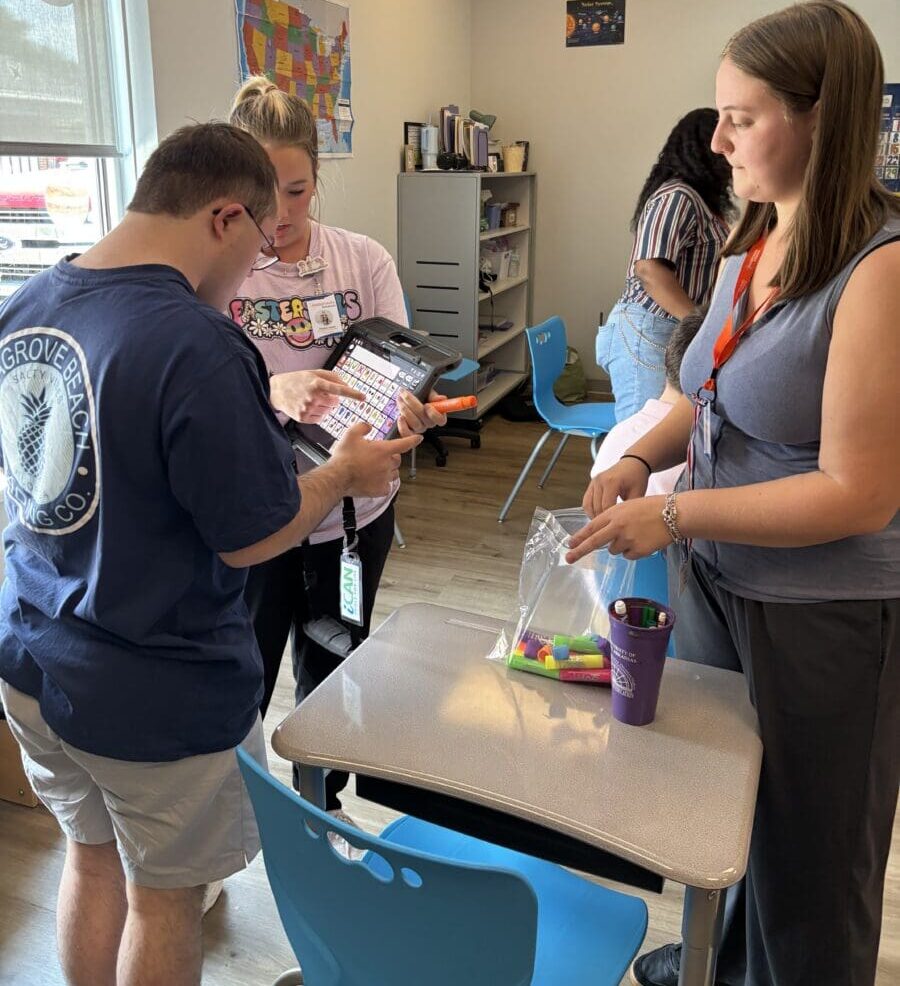
The best teachers never stop being students. For two University of Arkansas at Little Rock students, that lesson recently took on a new meaning when they found themselves teaching the teachers.
Claudia Slarks and Stormie Thirion, art education students and teacher residents, stepped into a role usually reserved for seasoned educators when they led a professional development session for practicing art teachers in the Little Rock School District (LRSD). Slarks, a teaching resident at Little Rock Central High School, and Thirion, a teaching resident at Carver-Washington STEAM Magnet Elementary School, worked alongside Dr. Emily Hood, assistant professor of art education at UA Little Rock. The students shared what they had learned about adaptive art instruction, turning their own classroom experiences into lessons for educators already in the field.
“Art teachers are going to have students across the ability spectrum in their classrooms, so it’s important for them to have opportunities to work with students with disabilities and learn how to adapt their teaching in real time,” Dr. Hood said. “Easterseals Academy gives our students a really supportive environment to do that. They can try out their lessons, see what works, make adjustments, and build relationships with their students. They may not leave with all the answers, but they leave knowing how to connect with students, listen to what they need, and adapt their teaching.”
The experience grew out of Dr. Hood’s Differentiation and Inclusion course, where future art teachers move beyond simply learning about inclusive instruction and put it into practice with real students. Students develop original curriculum, teach their lessons at Easterseals Academy — an accredited private school serving K-12 students with developmental disabilities in Central Arkansas — then reflect on what worked, what didn’t, and what they might change the next time. The process gives them an opportunity to adapt their teaching to the needs of the students in front of them and learn there isn’t one right way to teach a lesson.
“It’s alright for your plans to fall through sometimes. Lessons don’t always work; what counts is what you do afterward,” Thirion said. “I walked into Easterseals Academy with a lesson plan I had memorized, but quickly realized discussion wasn’t going to be possible. My first instinct was to panic, but I reminded myself why I was there: to help these students have fun creating.”
“I had the supplies and the lesson. I just needed to change the discussion, and it didn’t have to be perfect,” she added. “By the end, they had finished their expression stars and enjoyed making art. That was a success in my book.”
That experience changed the way the students thought about what it means to adapt a lesson. For Slarks, it meant recognizing that an unexpected student response could be an opportunity to rethink her approach rather than something that needed to be corrected.
“My biggest takeaway from my time at Easterseals is that adapting in the art room can be done in many ways, some unconventional,” Slarks said. “I began to see students ‘not doing what they’re supposed to be doing’ as an asset at times. The goal isn’t for the student to follow my instructions exactly as intended; the goal is for them to grow and learn.”
As they continued learning and adapting in the classroom, their work began to connect them with educators beyond the university. Stephanie Crowell, an art teacher at Carver-Washington Elementary, heard about Hood taking her students to Easterseals Academy and reached out while looking for additional ways to support students with disabilities in her own classroom. As she learned more, Crowell saw an opportunity to share those strategies with other art teachers, too.
At the training session, they shared useful ideas and lessons from their time at Easterseals Academy, giving teachers a glimpse into what adaptive art instruction can look like in practice. Instead of offering one set way to teach students with disabilities, they encouraged teachers to think about how each student can join in, communicate and create in their own way.
“The insights shared by the UA Little Rock team highlighting their experiences at Easterseals are incredibly relevant for public school educators,” Crowell said. “It was an empowering reminder that every teacher and student brings unique prior knowledge to the table – and when we share those different experiences, we create a richer, collaborative environment where we can all learn from one another.”
Now, as teaching residents in LRSD, they have another opportunity to put their experiences into practice. Becoming an effective teacher is not about reaching a point where there is nothing left to learn. It is about continuing to observe, learn, ask questions, and pivot when students need something different. For Slarks and Thirion, that means carrying what they have learned into each new classroom, knowing that every student brings another opportunity to learn, adapt and grow as educators.