
UA Little Rock Donaghey College of STEM Announces Faculty Excellence Winners
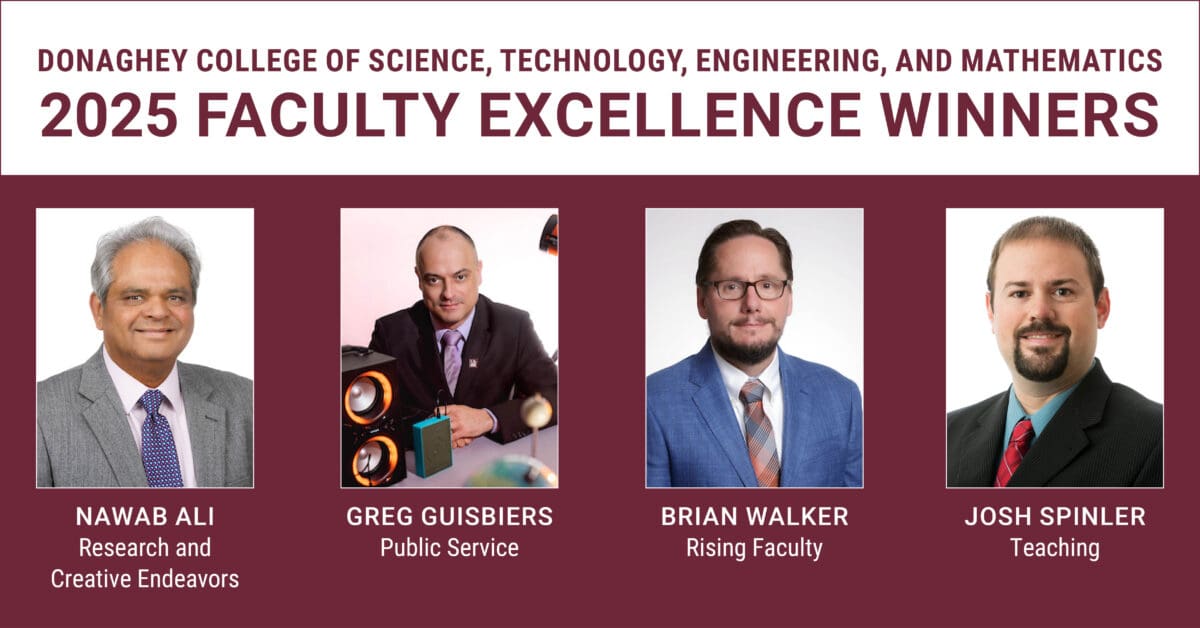
The UA Little Rock Donaghey College of Science, Technology, Engineering, and Mathematics (STEM) has named Joshua Spinler, Nawab Ali, Greg Guisbiers, and Brian Walker as the college-level winners of the 2025 Faculty Excellence Awards.
“The exceptional dedication, innovation, and passion demonstrated by this year’s Faculty Excellence Award winners truly exemplify the spirit of our college,” said Dr. Jeff Connelly, interim dean of the Donaghey College of STEM. “These winners have each made remarkable contributions to teaching, research, and service, enriching the lives of our students and strengthening our impact on the community and beyond. We are incredibly proud to celebrate their achievements and the inspiration they bring to our campus.”
The college recipients will be recognized at the UA Little Rock Faculty Excellence Awards on Thursday, April 3. The university-level Faculty Excellence winners will be announced at the ceremony that begins at 6 p.m. in the Schueck, McCarty, Lexicon Inc. Auditorium in the Engineering and Information Technology Building.
Faculty Excellence Award for Teaching
Dr. Joshua Spinler, advanced instructor and lab coordinator for the Geology program, has received the Faculty Excellence Award for Teaching, which is given to exemplars of the teacher/mentor model who maintain high expectations of their students.
“Dr. Spinler’s extensive contributions to teaching, his unwavering commitment to student success, and his continuous professional development make him a truly deserving candidate for the Faculty Excellence in Teaching Award,” Dr. Tansel Karabacak, director of the School of Physical Sciences, wrote in a recommendation letter. “Notably, he developed and redesigned several courses, including Geology of the National Parks, Earth Science in the Movies, and Geophysics, filling important gaps in the Geology curriculum and providing upper-level students with more opportunities to engage in critical thinking, both in the classroom and in the field.”
With a background in geophysics and tectonics, Spinler encourages his geology students to think about the “big picture” to better understand the processes that shape the world. He emphasizes experiential learning through hands-on activities, real-world case studies, and field trips to local, regional, and national sites.
Spinler directs the Field Geology II capstone course, a three-week intensive field mapping experience in the southern Rocky Mountains of Colorado and Wyoming. He has also played a key role in shaping field experiences for geology students by redesigning the Field Geology I course and co-developing Geology of the National Parks, a field-based course featuring week-long trips during spring break to destinations like the Grand Canyon, Saguaro National Parks, Big Bend, and Carlsbad Caverns National Parks.
In his 10 years at UA Little Rock, Spinler has taught 12 distinct courses across multiple formats, from introductory geology lectures and labs to upper-level and graduate courses in structural geology and geophysics. He has developed three new courses and collaborated with faculty to establish a Certificate of Proficiency in Earth Science.
“I am humbled that my peers have both nominated me for and selected me to receive this prestigious award from our college,” Spinler said. “I strive every day to have my students further develop their ‘sense of place’ in that after they leave my classes, they have a more complete understanding of the world around them, what processes go into shaping that world, and how that world changes over time, from both natural and human-driven changes. If we better understand the world around us, we can be more successful stewards of the one and only planet we call home.”
Faculty Excellence Award for Research and Creative Endeavors
Dr. Nawab Ali, professor of biology and graduate coordinator, is the recipient of the Faculty Excellence Award for Research and Creative Endeavors. He is a 25-year-veteran of the university, specializing in biochemistry, signal transduction, and cancer research. The Faculty Excellence Award for Research and Creative Endeavors is given to those who have contributed to the expansion of knowledge and the quality of life in a particular field.
With postdoctoral training from premier institutions such as the National Institute of Environmental Health Sciences and Yale University, his research explores how inositol polyphosphates regulate cellular processes like apoptosis, with implications for cancer and neurodegenerative diseases. His work has earned international recognition, with publications in high-impact journals and citations in top-tier scientific literature.
Ali is a pioneer in the study of G-proteins, G-protein-coupled receptors, and their role in intracellular signaling. His groundbreaking discovery that the enzyme MinPP1 functions within the endoplasmic reticulum and contributes to cancer progression has reshaped the understanding of this enzyme’s role in disease. Expanding on this research, he is currently developing nanotechnology-based therapeutic approaches for breast and pancreatic cancer.
Throughout his career, Ali has secured more than $1.9 million in research funding, including grants from NSF, NASA, and AR-INBRE. He has authored more than 100 peer-reviewed papers and book chapters, with over 2,600 citations. His contributions to biomedical research and nanotechnology continue to advance scientific understanding and bring prestige to UA Little Rock.
“It is a wonderful feeling to have received UA Little Rock’s most prestigious Excellence in Research Award,” Ali said. “This research award is a token of recognition for the endeavors that my team and I have put in over the years in the area of my research, cancer biology. I have always enjoyed working with undergraduate and graduate students, and collaborators who have significantly contributed to this success. I am thankful to all my collaborators, especially Dr. Noureen Siraj who nominated me for this award. The award will go a long way to encourage us to continue exploring and testing new ideas and make discoveries that will enhance our scientific knowledge on cancer prevention and treatment.”
Faculty Excellence Award for Public Service
Dr. Greg Guisbiers, associate professor of physics and astronomy, has been selected as the winner of the Faculty Excellence Award for Public Service. The recipient of this award applies their skills to their disciplines in service to the community, state, or nation in areas of public interest.
During the summer 2023 to spring 2024, he prepared the campus to host an event to celebrate the Great North American Eclipse. Guisbiers helped to secure a grant from the Arkansas Space Grant Consortium to purchase more than 50 telescopes for the event, as well as brought two light sound devices from Harvard University to help the blind and visually impaired experience the solar eclipse in a unique way.
On April 8, 2024, more than 4,000 people converged at the Jack Stephens Center to watch the eclipse and participate in a wide range of family friendly, educational activities. Guisbiers gave multiple interviews to TV, radio, and print journalists, helping showcase the university’s scientific expertise to the community.
“His leadership and collaboration in planning the UA Little Rock Solar Eclipse Event exemplify the spirit of public service that strengthens and supports the broader university community,” said Dr. Carrie Phillips, chief communications and marketing officer. “Dr. Guisbiers went above and beyond to support the event’s success and elevate UA Little Rock’s public profile. He willingly stepped into new roles, conducting TV and radio interviews, filming social media videos, presenting to community groups, and even speaking at local churches—all to ensure the event reached diverse audiences.”
Following up on the momentum and excitement created by the Great North American Eclipse, Guisbiers has worked to revive the long-closed campus observatory. He worked with a team of physics students and Facilities Management to clean out, renovate, and install a new telescope in the observatory. Thanks to the financial support from the Provost’s Office, this project was finally achieved during the fall 2024 semester.
“Receiving this award is a wonderful recognition of all the efforts I invested into organizing the Great North American Eclipse observation on campus as well as in getting the observatory operational again,” Guisbiers said. “I feel that I have served our community very well, and this feeling makes me very proud!
Faculty Excellence Award for Rising Faculty
Dr. Brian Walker, an assistant professor of chemistry, has received the Faculty Excellence Award for Rising Faculty, which is given to faculty members in their first five years at UA Little Rock who display exceptional promise in teaching, research or creative endeavors, or public service.
“Dr. Walker exemplifies the qualities of an outstanding researcher, educator, and leader,” Dr. Noureen Siraj, associate professor of chemistry, wrote in a recommendation letter. “His accomplishments in advancing synthetic organic chemistry, mentoring diverse students, delivering exceptional teaching, and serving the academic community make him a highly deserving candidate for the Rising Faculty Award.”
Walker has built a strong record of research in organic synthesis and medicinal chemistry, securing more than $240,000 in funded projects. Committed to teaching and mentoring students, he received the 2023 Research Mentor Award from the Arkansas Louis Stokes Alliance for Minority Participation and was named the 2021 Professor of the Year by the American Chemical Society (ACS) Central Arkansas Local Section.
Beyond research, Walker is actively engaged in professional and community service. Currently serving as the 2025 Chair of the Central Arkansas Section of the American Chemical Society, he also holds editorial responsibilities for chemistry journals, serves as a science fair judge, and leads chemistry outreach initiatives. Within the university, Walker contributes to various committees, including student recruitment and curriculum development, while also leading instrumentation improvements for the chemistry program and the School of Physical Sciences.
“I was thankful to be nominated for the faculty award,” Walker said. “Winning it is an honor and reaffirms my commitment to education, leadership, and community engagement, all which continue to shape my role as an educator and researcher.”