
A Calling Reclaimed: April Muhammad’s Path from Grief to the Law
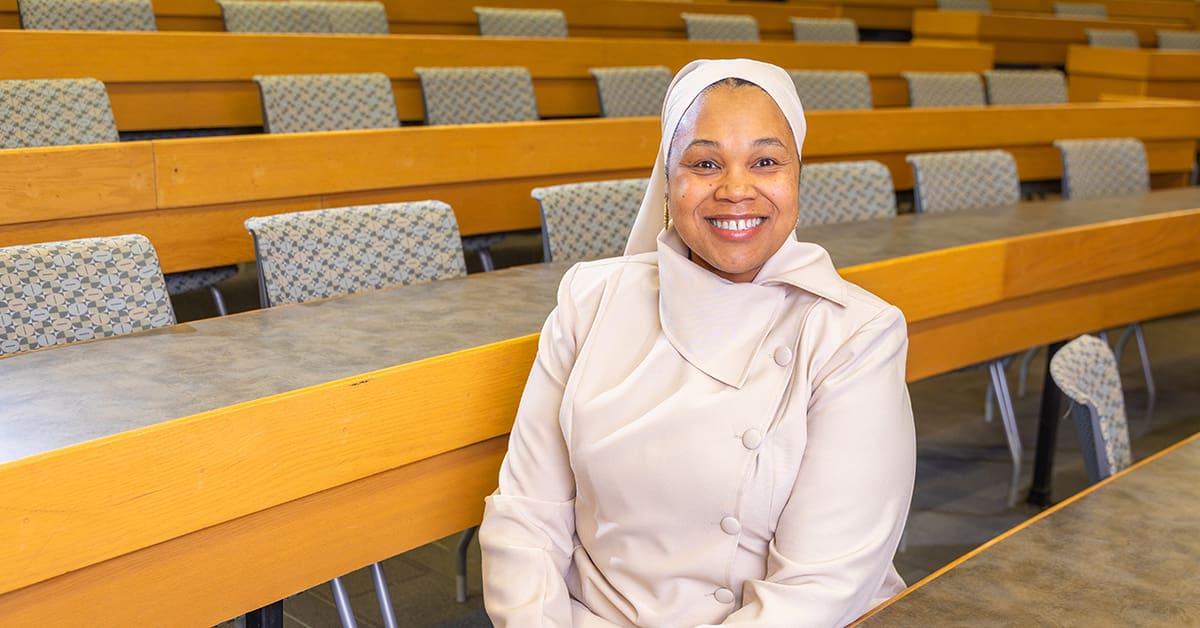
In the quiet months after her husband’s death, April Muhammad found herself searching for direction. She had poured years into caregiving and motherhood, and for the first time in a long time, the path ahead was her own to choose. That clarity led her back to a dream she first spoke aloud on a dusty Mississippi road as a young girl, when she and her sister imagined futures bigger than their small, segregated town seemed to allow. Muhammad wanted to be a lawyer.
At the time, Muhammad was already enrolled in a Ph.D. program in business leadership — but the work felt hollow. The more she studied, the more she realized it wasn’t what she was meant to do. What pulled at her instead was a deeper need she couldn’t ignore: the persistent gap between people in crisis and the legal help they needed. She had grown up in a place where families struggled in silence, and now she saw how many others still faced those same barriers. If she was going to start over, she wanted it to matter.
Muhammad’s path to law school began with Bowen’s LEAP program, a selective summer initiative that gives high-potential students a chance to prove they are ready for the demands of legal education. She was one of just four students to matriculate that year. “LEAP was harder than any semester of law school,” she said. “It was daily classwork, new material, and it came fast. You couldn’t slack, and I’m thankful for that because it prepared me for what was to come.”
Muhammad made that commitment from Pine Bluff, driving nearly two hours each day to attend classes and study at Bowen. A mother of eight, she balanced coursework with caregiving and a full household, often spending eight to ten hours a day in her carrel on campus. Her youngest son, Ausar, a high school student in Little Rock, spent countless hours with her at the law school, reading in the library or waiting outside classrooms. She began in the part-time program and later transitioned to full time, taking on heavy course loads without slowing down. She completed her degree in just three and a half years, a reflection of her focus, discipline and determination.
At Bowen, Muhammad found more than academic rigor. She found mentors who saw her potential and helped shape her into a practicing advocate. As a Rule XV certified student, she represented real clients in the Delta Divorce Clinic, arguing their cases in court under the supervision of Professor Suzanne Penn. “I was so nervous, but when the judge said I did a good job, I knew I was exactly where I was supposed to be,” she said. She also completed an externship with Chief Judge Phyllis Jones of the U.S. Bankruptcy Court, gaining insight into how judges interpret complex legal issues. Faculty members like Danna Young and Dean Rejena Grotjohn were never far when Muhammad had questions or needed encouragement. Their couches, as she fondly described them, were places to learn and be heard.
While her professors helped shape her as a lawyer, Muhammad’s greatest champions were often behind the scenes. A few years ago, she remarried, and her husband, Bilal Muhammad, supported her every step of the way, from cooking and cleaning to giving her space to study. Her sisters, Carolyn and Lydia, were constant encouragers, sending shirts with messages like “J.D. Loading” and reminding her that she could do anything she set her mind to. Muhammad also carried the quiet motivation of her mother, who spent her career cooking in a hospital cafeteria but once confided that she had always dreamed of being a nurse. That revelation stayed with Muhammad. “I have one life,” she said. “I want to do what I was born to do.”
This weekend, Muhammad will graduate from the UA Little Rock William H. Bowen School of Law and begin a prestigious clerkship in the chambers of Chief Judge Jones of the U.S. Bankruptcy Court for the Eastern and Western Districts of Arkansas, where she once served as a student extern. The courtroom is no longer a dream. It is where she belongs, where purpose meets preparation, and where she is ready to lead.