
A Community Built: How Chacey Schoeppel Wilcox Became the Person Classmates Turned To
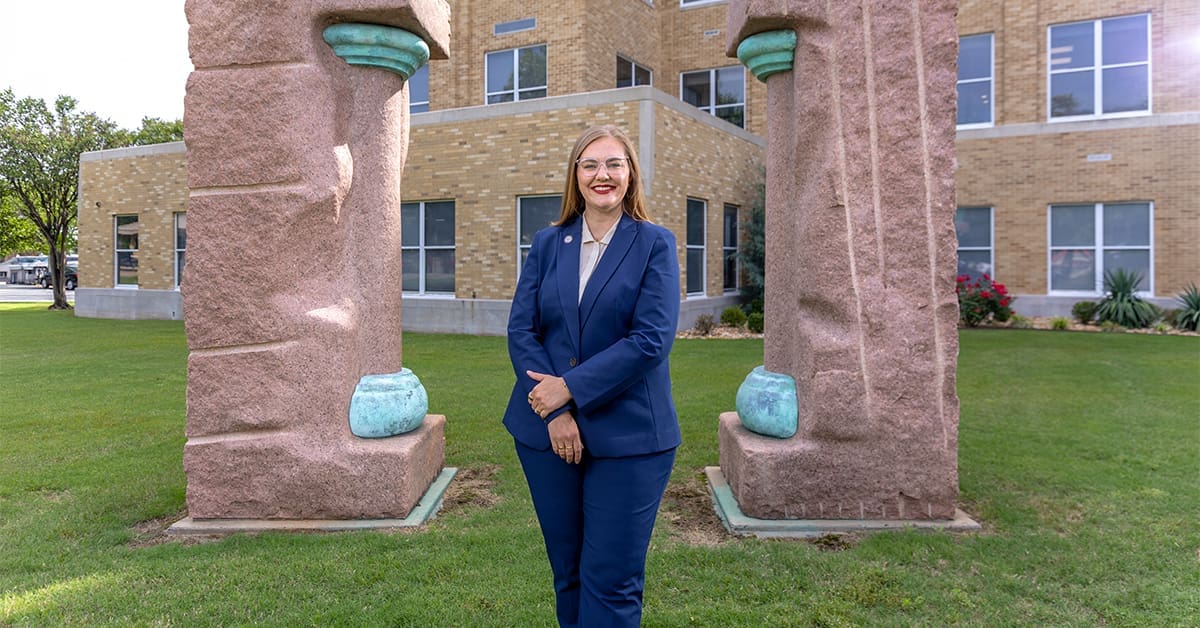
As one of her classmates drove to a lunch meeting with a potential employer, she made a call — not to a professor or a career advisor, but to Chacey Schoeppel Wilcox, with one question: how do you ask for a job?
It is the kind of moment that does not show up on a résumé, but over time, it became a familiar one. Schoeppel Wilcox, who is nearly a decade older than many of her classmates, took on a big sister role for many during her time at the UA Little Rock William H. Bowen School of Law. They turned to her, not just for help with coursework, but for guidance on the practical decisions that shape daily life and professional confidence. She has talked peers through mock interviews, how to get a car loan, and how to choose a primary care provider.
In a place where students spend long hours together, often learning how to navigate unfamiliar environments alongside one another, those moments of trust can carry real weight. For Schoeppel Wilcox, they became some of the most meaningful parts of her experience at law school.
Schoeppel Wilcox was recently awarded the Bogle-Sharp Award, which goes to the graduate who is voted “most likely to succeed in the practice of law” by their peers. “I can’t think of any honor greater than one from those that have endured the trenches of law school with you,” she said.
Long before classmates began turning to her for advice, Schoeppel Wilcox was learning from the people who quietly showed up for others in her own life.
She grew up in Fairview, Oklahoma, a rural town where her graduating class numbered just 36 students. Her mother taught middle school and often found understated ways to help families around them. If a student came to school without a winter coat, one might quietly appear a few days later in exactly the right size.
“No one needed to know that she did it,” Schoeppel Wilcox said. “You just meet people’s needs where you can.”
She saw the opposite side of that reality, too. Her father, a lawyer, died when she was seven after what she describes as a difficult and often painful marriage for her mother. Even with a college degree, a stable job and support from family, her mother was left trying to navigate financial systems and responsibilities she had never been allowed to manage on her own.
Over time, Schoeppel Wilcox began to recognize how many forms uncertainty can take, especially for people trying to enter unfamiliar professional spaces. She said she was fortunate to grow up surrounded by friends whose parents stepped in to help fill gaps when they saw them. “One of my friends’ dads taught me how to get a car loan,” she said. “Those aren’t things everyone gets taught.”
Before law school, she worked in public service roles in Oklahoma and Arkansas, spent time working for a nonprofit in South Africa and helped run internship programs in multiple settings. Again and again, she found herself working with people who often already knew what they wanted for themselves and their families, but lacked access to resources, information or professional networks that could help them get there.
“I think people usually know what they need,” she said. “Sometimes they just need someone to help guide them through it.”
During law school, life outside the classroom rarely slowed down for Schoeppel Wilcox.
She and her wife Amie married just weeks before classes began at Bowen. During her first year, they renovated a 100-year-old home in Hillcrest while she adjusted to the demands of legal education. Throughout law school, she balanced classes with clerkships, externships and research work at the school.
Then, during her second year, just weeks after she was named editor-in-chief of the UALR Law Review, her mother died unexpectedly.
During that same period, Schoeppel Wilcox and her wife navigated fertility treatments, a miscarriage, the responsibility of settling her mother’s estate and helping care for her aunt in hospice in Oklahoma, all while continuing through law school.
“You want to show up for everybody and do a good job and do it right,” she said. “But it’s hard to balance it sometimes.”
At home, she and her wife relied on a simple framework for making decisions during overwhelming seasons: knowing which responsibilities were “glass balls” and which were “rubber balls.”
“The rubber balls bounce back,” she said. “The glass balls break.”
Sometimes that meant missing a class to handle a family emergency and catching up later. Other times, it meant accepting support from the same community she had spent years supporting herself.
When her mother died, several classmates drove from Little Rock to Oklahoma for the funeral, a 14-hour round trip. Friends brought freezer meals, shared class notes and helped however they could. Faculty members, including Dean Gustafson and Professor Laura Bates, became steady sources of support and guidance throughout law school.
For Schoeppel Wilcox, those experiences reinforced the kind of community she had found at Bowen — one built not only through academic rigor, but through people continuing to show up for one another when life became difficult.
As editor-in-chief of the Law Review, Schoeppel Wilcox found herself responsible for keeping one of the law school’s most demanding student organizations moving forward.
“The role of the editor-in-chief is keeping the train on the tracks,” she said.
The position required her to manage the publication process, coordinate with students and faculty and review every article that moved through the Law Review, all while balancing coursework, externships and responsibilities outside the classroom.
For Schoeppel Wilcox, leadership was less about authority than consistency. Early on, she worked to make sure everyone understood their responsibilities and trusted one another to carry them out. “The clearest communication and assuming best intent of somebody,” she said, “those are the two things I always try to take into a role like that.”
The experience reinforced what had already become central to her time at Bowen: leadership often meant helping other people do their best work.
This weekend, Schoeppel Wilcox will graduate from Bowen Law after years defined as much by service and resilience as academic achievement. Following graduation, Schoeppel Wilcox will begin a two-year judicial clerkship with Chief U.S. District Judge Kristine G. Baker before joining the Rose Law Firm as a litigation associate. She said her externship with Judge Baker reaffirmed her belief in the legal system at its best: one grounded in preparation, fairness and respect for the people moving through it.
“There really is no substitute for being in the courtroom and watching it happen,” she said.
For Schoeppel Wilcox, the path to this point has rarely been linear or uncomplicated. But as she prepares to graduate, she is thinking less about achievement than about the opportunities people create for those who come after them.
She recently learned that her grandfather once started law school himself before leaving to support his family, a decision that shaped the choices available to those around him. Her father eventually became a lawyer, while her mother, the first in her family to attend college, became a teacher because, as Schoeppel Wilcox recalls, she “didn’t really know what else you could be other than that or a secretary.”
Now, as she and her wife prepare to welcome their first child later this summer, Schoeppel Wilcox hopes the life they are building will offer their child more freedom and possibility than earlier generations had themselves.