
Nine UA Little Rock Students Present STEM Research at Arkansas State Capitol
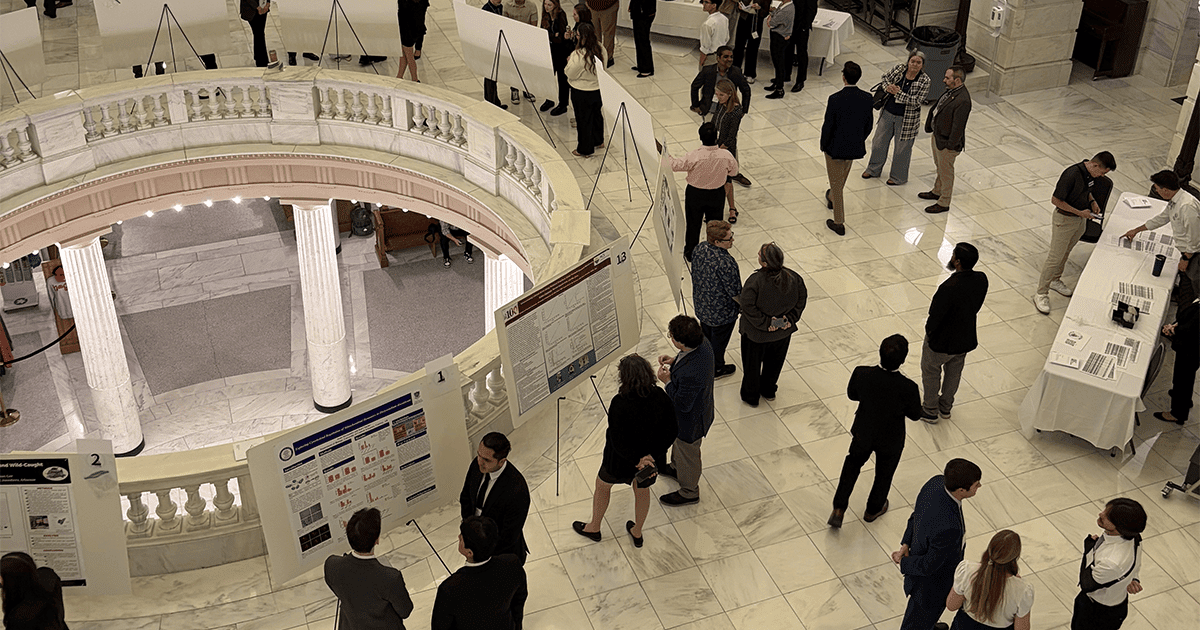
Nine students from the University of Arkansas at Little Rock recently showcased their research at STEM Posters at the Capitol, an annual event held at the Arkansas State Capitol that highlights student-led research from across the state.
STEM Posters at the Capitol provides students with the opportunity to share original research with state lawmakers and fellow researchers while demonstrating the impact of STEM innovation happening across Arkansas.
Representing UA Little Rock, the nine graduate and undergraduate students presented projects addressing real-world challenges in fields ranging from medical data analysis and data science to energy resources, biology, and chemistry.
Undergraduate student Kolton Claybrook, a senior double major in chemistry and business administration with a focus in entrepreneurship, presented research focused on developing cost-effective methods for concentrating lithium from brine water found in the Smackover Formation in southern Arkansas. The research addresses the growing demand for lithium, a critical element used in batteries and energy storage technologies.
“Presenting at the Capitol was a very fun and rewarding experience,” Claybrook said. “Speaking with peers and faculty across the state created great dialogue about the innovations happening right here in Arkansas.”
Claybrook added that the event also provided valuable networking and presentation experience as he prepares for his future career.
Ammar Ahmed Taha Mohammed, a graduate student in information science, presented research on entity resolution, a process used to determine when different records refer to the same person or household despite inconsistencies or incomplete information. Mohammed said this work is particularly important for fields such as healthcare and government, where inaccuracies in data can have serious consequences.
“Presenting my work at the Arkansas State Capitol was surreal and deeply inspiring,” Mohammed said. “What stood out most were the thoughtful and engaging conversations. It was exciting to see people from diverse backgrounds connect with the broader significance and real-world applications of my research.”
For Joie Lea Murorunkwere, a fourth-year Ph.D. candidate in applied science with a concentration in applied mathematics and statistics, the event offered a chance to highlight how advanced statistical techniques can improve medical research. Murorunkwere’s project examined melanoma treatment outcomes from different therapies using resampling-enhanced survival analysis.
“Presenting at the Arkansas State Capitol was both exciting and meaningful,” Murorunkwere said. “It gave me the chance to share why rigorous, data-driven methods matter for real health decisions. As a student researcher, this experience strengthened my confidence and reinforced my commitment to research that can make a practical difference.”
Events like STEM Posters at the Capitol allow students to share their work beyond the classroom while highlighting innovative research happening at UA Little Rock. By connecting students with policymakers, faculty, and researchers from across the state, the event demonstrates how student-led research contributes to solving real-world challenges in Arkansas and beyond.
Presenters included:
- Kolton Claybrook, Computer Science, “Concentrating Lithium Brine Using Reduced Graphene Oxide Forward Osmosis Membranes”
- Ammar Ahmed Taha Mohammed, Information Science, “A Hybrid Entity Resolution Pipeline Integrating LLM Intelligence, Semantic Clustering, and Household Movement Analysis”
- Hannah Jones, Engineering, “Detecting the Undetectable: Methods to Detect BVID in Wind Turbine Blade Samples”
- Ruby Bagchi, Biology, “Cinnamic Acid Modulates Iron Deficiency Responses in Soybean Through Improved Phenotypic Performance and Regulation of Iron Homeostasis-Related Genes”
- Mohammed Naif, Chemistry, “Improved Electrode for Lithium-Sulphur Battery”
- Eshaal Nadeem, Chemistry, “Emerging Ionic Nanomedicines: Synthesis, Characterization to In Vitro and In Vivo Performance”
- Joie Lea Murorunkwere, Mathematics, “Resampling-Enhanced Survival Analysis of Adjuvant Versus Neoadjuvant Therapies in Melanoma Using Kaplan-Meier Estimation, Weighted Log-Rank Tests, and Time-Dependent Cox Models”
- Meherun Nesa Shraboni, Computer Science, “A Gaze-Aware XR Framework for Synchronizing Head-Based Interaction and Eye-Movement Analysis”
- Kalyn You, Chemistry, “Advanced Material Platforms for Stretchable Bioelectronics and Flexible Circuitry”