
Exploring the Human Mind: Inside UA Little Rock’s Innovative Psychology Labs
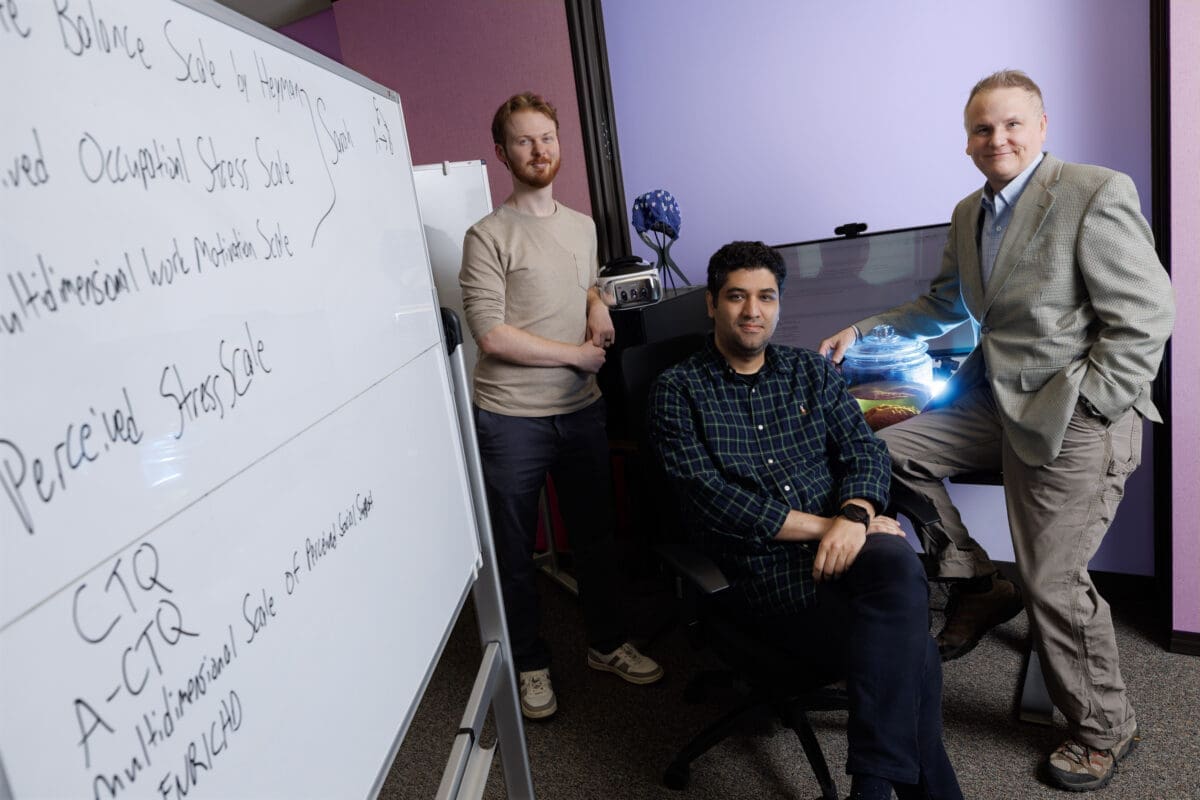
What happens when people don’t get enough sleep? How does financial stress change the way we think? And what does it mean to interact with a system that can think back?
At the University of Arkansas at Little Rock, psychology researchers are exploring these questions through a growing network of labs focused on sleep, cognition, and human-AI interaction.
Across three specialized lab spaces, faculty and students are examining how biological, cognitive, and technological forces intersect to shape human behavior. From tracking brain activity during sleep to modeling how stress affects memory and studying how people interact with AI systems, their work is helping answer questions that are increasingly relevant in everyday life.
Measuring Sleep and Its Consequences
In the department’s Biobehavioral Laboratory, often referred to simply as the sleep lab, Dr. David Mastin studies how sleep and sleepiness affect everyday life.
Sleep affects nearly every aspect of daily functioning, from reaction time and memory to mood and overall health. According to Mastin, many people operate at a deficit without realizing it.
“Almost everyone carries a sleep debt,” he said. “It’s like being overdrawn in your checking account. You owe your body sleep.”
He also notes that modern life makes that debt difficult to avoid, as artificial light, technology, and constant stimulation can disrupt natural sleep patterns and keep people from getting the rest they need.
That deficit can have serious consequences. Even one night without sleep can significantly impair performance.
“If you pull an all-nighter and we put you on a driving simulator, you would make as many mistakes as someone who is legally drunk,” Mastin said.
The space is equipped with tools designed to measure brain activity, including electroencephalography (EEG), which tracks brain waves during different stages of sleep. A nap bed and observation room allow researchers to monitor eye and body movement without disturbing participants, while biofeedback equipment measures the body’s physiological responses to different stimuli.
Beyond these tools, the lab also relies on controlled sleep tests that measure alertness and fatigue, providing objective data that can be compared with how participants report feeling.
Much of the lab’s research extends beyond campus. Mastin and his students frequently work in the community. Right now, for instance, they are studying firefighters to better understand how sleep impacts performance in high-stakes environments.
As part of this research, Mastin and his students attended a firefighter convention in Hot Springs to interview participants about their sleep habits. The next step is to digitize the survey to reach firefighters across different regions and cultures, with the goal of improving both their well-being and performance.
Students play an active role in the research process, contributing to ongoing studies and developing their own projects under faculty guidance. Through this work, the lab connects physiological measurement with real-world behavior, bridging psychology with biological and health sciences to show how sleep quietly shapes nearly every part of daily life.
Understanding How We Think Under Stress
Just down the hall, Dr. Colton Hunter’s cognitive psychology lab focuses on how stress shapes the way people process and remember information.
Hunter’s research centers on working memory, the short-term ability to hold and manipulate information. Specifically, he studies how socioeconomic status influences cognition, examining how stress from factors such as income, education, and environment contribute to changes in how people process and recall information — highlighting how psychological processes are shaped by broader economic and social forces.. His primary research examines the effects of financial worry on working memory.
“The idea is that your financial problems might be occupying mental resources,” Hunter said. “It’s like the equivalent of having too many tabs open on your computer. It’s going to slow down performance.”
In one common task used in his lab, participants are briefly shown a set of colored squares before the image disappears and reappears. They are then asked to determine whether anything has changed. While the task appears simple, it allows researchers to measure how much information a person can hold in mind, how accurately they respond, and how quickly they process what they see.
These tasks are paired with socioeconomic survey data and written responses in which participants reflect on financial stressors, personal challenges, and neutral daily experiences. Hunter’s research explores whether financial stress uniquely impairs cognitive performance compared to other types of stress.
“The idea is that for participants from lower socioeconomic backgrounds, writing about financial worries would potentially take away from their working memory performance more than a neutral event, but also more than any other type of stressor,” Hunter said. “There’s something special about financial stress.”
A key feature of the lab is a high-powered computing system that allows Hunter to run complex statistical models and analyze large amounts of data quickly — work that would otherwise take days or even weeks.
The lab integrates students into every stage of the research process. Undergraduate participants contribute to ongoing studies as participants, while others serve as research assistants through independent study, gaining hands-on experience in experimental design, data collection, and analysis. This approach also allows Hunter to examine how financial worry affects cognition specifically within the student population.
Studying the Future of Human-AI Interaction
In the department’s newest lab, Dr. Mohsen Rafiei is exploring one of psychology’s quickest evolving frontiers — how humans interact with artificial intelligence.
Rafiei’s lab focuses on human-AI interaction, examining how people use, interpret, and trust increasingly sophisticated systems.
“We are trying to understand how people interact with AI,” Rafiei said. “We want to understand how you as a human being interact with a smart system so we can learn to optimize that system for you.”
One current project looks at how students use AI in their daily lives, including whether they trust the results from their questions — and whether or not that trust is warranted.
“AI systems are probabilistic, which means there is always a good chance they are wrong,” he said. “Many students don’t know this and trust whatever answer they are given. Our goal is to learn how to optimize this so we can address this problem.”
To study these interactions, Rafiei’s lab is equipped with advanced tools that allow researchers to observe both behavior and brain activity in real time. Eye-tracking technology reveals where users focus their attention on a screen, while EEG and functional near-infrared spectroscopy (fNIRS) systems measure which areas of the brain are active during interaction. Virtual reality headsets allow researchers to build immersive environments — such as a classroom with an AI assistant — and study how people respond in more lifelike scenarios.
The lab also houses an incredibly powerful computer, known as an AI cluster, that allows researchers to run and customize AI models locally. By operating outside of internet-based systems, the lab can test models in a controlled environment without privacy concerns, giving researchers the ability to study how people interact with AI systems specifically designed for the experiment.
Together, these tools allow Rafiei and his students to examine not only what people do when interacting with AI, but also what is happening in their minds as they do it.
The work is inherently interdisciplinary, combining psychology with neuroscience, computer science, and physiology to better understand how humans engage with increasingly intelligent systems.
Students play a key role in that process, gaining hands-on experience working with AI models and advanced research tools. Skills gained in this lab prepare them for emerging careers in human-AI interaction.
“This is a new field,” Rafiei said. “We know about human cognition and perception, but how do we interact with another intelligent system? We don’t even know all the questions we need to ask yet.”
As AI systems become more advanced and increasingly human-like, the challenge becomes even more complex.
“It’s not like interacting with a tool,” he said. “It’s more like interacting with another intelligent being. And there are still so many open questions we need to answer.”
Looking Ahead: Expanding Innovation in Psychology
Across all three labs, a common thread is clear: the future of psychology at UA Little Rock is increasingly hands-on, interdisciplinary, and grounded in real-world impact.
For Dr. Sherwin, chair of the Department of Psychology, the new labs mark a turning point in the department’s identity.
“Research has clearly become more prominent,” she said. “We’re intentionally building a department that is more uniformly engaged in research.”
That shift is being driven in large part by new faculty hires, whose work is expanding both the scope and scale of research opportunities available to students. In the past, demand for research experience often outpaced availability. Now, that dynamic is reversing.
“We went from having more students than research opportunities to suddenly being in the opposite situation,” she said.
As the department grows, so does its emphasis on preparing students for careers beyond the classroom. Through lab work, students gain practical experience in skills Sherwin says are valuable across industries such as data analysis, problem-solving, and communication.
To support that growth, the department is also introducing a new “Research Experience” course this fall, designed to give students earlier and more accessible entry into lab work. The course allows students to begin developing research skills before moving into more independent, advanced projects.
“People don’t always realize how marketable research skills are,” Sherwin said. “That’s really where our discipline shines at the undergraduate level — teaching students how to manage and present data, think critically and analytically, and answer questions effectively.”
As psychology continues to intersect with fields like artificial intelligence, neuroscience, and data science, the work happening at UA Little Rock is positioned at the forefront of that shift.
With new labs, advanced technology, and a growing emphasis on student-driven research, the department is not only keeping pace with the future of the discipline — it is helping define it.