
UA Little Rock Building Chicago’s 78th Neighborhood: UA Little Rock Students Capture National ‘Best Pitch’ Title UA Little Rock
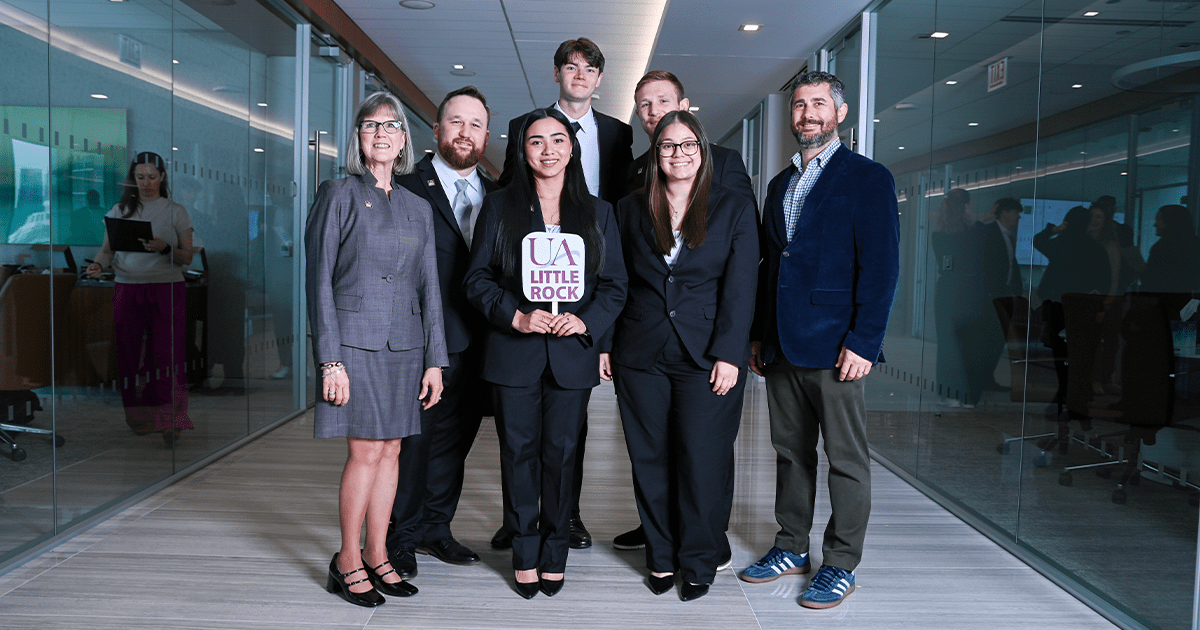
The University of Arkansas at Little Rock Real Estate Team received the “Best Pitch” award at the 16th annual Harold E. Eisenberg Foundation Competition in Chicago, competing against 21 undergraduate teams from across the country.
The team’s proposal focused on The 78 — a 62-acre site along the South Branch of the Chicago River that is planned to become Chicago’s 78th neighborhood. The development includes the future McDonald’s Park stadium, a major sports and entertainment destination, in partnership with the Chicago Fire FC soccer team, designed to support year-round activities.
Representing UA Little Rock were students Brennan Gasaway, Ashley Lopez, Isabel Hortelano, Kodiak Cannedy, and Ryan Hunt, who competed as BAIKR Development, a team name built from each member’s initials. The team developed the award-winning proposal with guidance from industry experts Siteng Ma and Andy Ahitow, while Elizabeth Small, an instructor of real estate, served as the academic advisor throughout the competition.
“Developing this pitch taught us patience, discipline, commitment, and teamwork,” the team said. “As the project evolved, we all became deeply invested in the vision, and receiving this recognition validated the hard work and passion we put into it.”
The proposal centered on creating a mixed-use district guided by the principle of “people first, buildings second,” with an emphasis on building a development that complemented the surrounding neighborhoods while supporting long-term activity beyond stadium events.
Taking Ma’s advice to follow the “Live, Work, Play” concept, the team focused on creating a development that complemented the existing neighborhoods and future McDonald’s Park stadium while giving the 78th neighborhood its own identity.
For “Live,” the students envisioned a walkable residential community with a mix of affordable and market-rate housing designed for students, families, and working professionals, creating a stable environment year-round.
For “Work,” the proposal introduced office, retail, hospitality, and educational spaces anchored by a Culinary and Hospitality Institute designed to support workforce development and generate daily activity within the district.
For “Play,” the team incorporated restaurants, entertainment venues, hospitality spaces, and public gathering areas intended to extend activity beyond game days while supporting both residents and visitors.
As the project developed, the team focused on creating a district that could sustain activity beyond major stadium events. With McDonald’s Park serving as a major anchor for the district, the team introduced the Culinary and Hospitality Institute as a second anchor tenant designed to support workforce development, hospitality training, and year-round engagement.
“We wanted to stay focused on building a community that recognized and included the people already surrounding the space,” Hortelano said. “A big part of our approach was making sure the development felt welcoming and connected to the existing neighborhoods rather than creating something that isolated or displaced them.”
Small encouraged the students to look beyond the site itself and understand the surrounding demographics as real people and neighborhoods, a perspective that shaped many of the team’s design decisions throughout the project.
“We could see how much the team genuinely believed in its pitch, and we were impressed with how they created an ecosystem that could grow organically with the surrounding community over time,” one competition judge said.
Throughout the development of their pitch, team members reached out directly to industry professionals and businesses to test ideas and refine the proposal’s feasibility.
“We were all really surprised how open all of the professionals we spoke to were,” said the team, “We spent a lot of time on the phone or talking over email about all of our options, and which made the most sense for the development.”
As the team refined the project, members said their collaboration became one of the group’s greatest strengths.
“Becoming friends made everything much easier,” Lopez said.
What began as a competition project ultimately became a collaborative learning experience that challenged the students to think beyond the classroom. Through countless conversations, revisions, and real-world outreach, team members said they developed stronger friendships, discovered their individual passions within the project, and gained a deeper understanding of how thoughtful developments can shape communities. Their success at the Eisenberg Competition reflected not only the strength of their proposal, but also the teamwork and shared vision behind it.