
UA Little Rock Hosts AI Pitch Competition
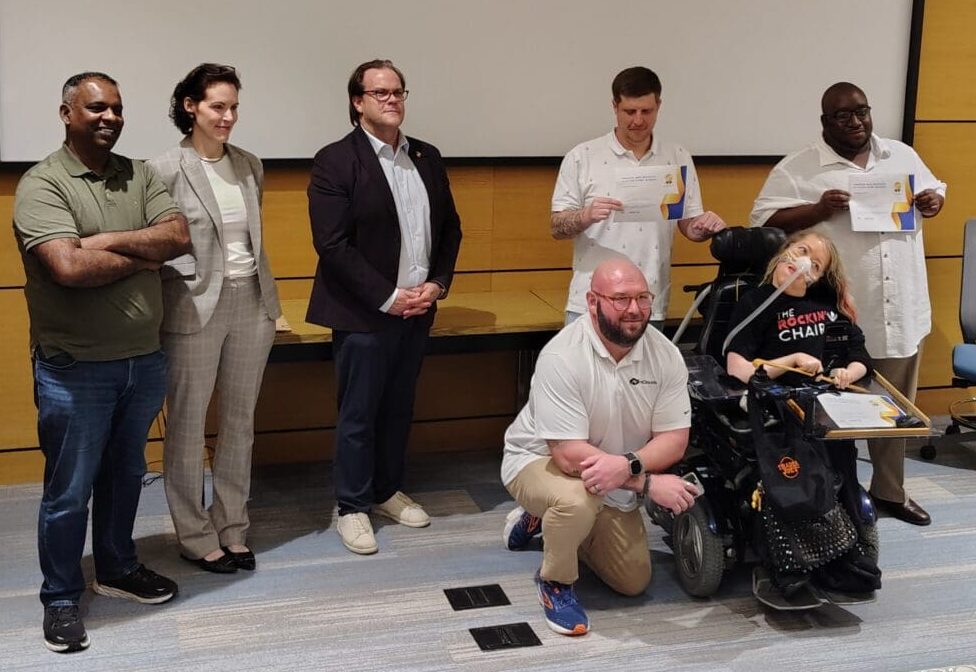
Kelvin Bell took top honors at the University of Arkansas at Little Rock’s second annual Amazon Web Services (AWS) AI Pitch Competition with his idea for an artificial intelligence (AI) agent that helps restaurants manage phone calls and other service tasks.
“There’s a need for this (service), because it solves the problems for an industry known to have high operating costs and low profit margins,” said Bell, founder and CEO of Stratos Digital. “I’ve been into technology since I was 7 years old, so this is the manifestation of a dream I’ve had my whole life.”
Arkansas entrepreneurs with innovative ideas for transforming business operations and accelerating growth with AI competed for a chance to win up to $50,000 in services at the Oct. 15 competition hosted by the Arkansas Small Business and Technology Development Center (ASBTDC), along with UA Little Rock’s School of Business, Tech Launch, and the Workforce Development Center. The runner-up and third-place finisher for the judged competition also won prizes, $35,000 and $25,000, respectively.
Funding has been Bell’s top challenge as he tries to build his enterprise — “nobody wants to help startups these days” — so the $50,000 in services will be critical, he said. Winning is “humbling and great, exactly what we need to build our enterprise on one of the best platforms in the world.”
To pitch, entrepreneurs had to apply for a spot in the competition, and those selected pitched their concept in front of judges with the chance to win AWS Partner funding allocated toward technical resources, architecture support, and solution development services delivered by nClouds in collaboration with AWS (subject to program eligibility and scope). All competitors received expert feedback on how to bring their concepts to life.
“The different pitches showed that our Arkansas small businesses and entrepreneurs have highly creative ideas, and now the three winning companies will get some amazing support in accelerating their ideas with AI,” said ASBTDC State Director Laura Fine. “We appreciate Amazon Web Services, nClouds, and all the partners who joined us in making this engaging event possible.”
For those hoping to follow Bell’s pitch success, he recommends research and following passion.
“Do your research, know your customers and competition, and optimize your pitch based on your passion,” Bell said. “I’m very, very passionate.”
The Victor AI platform answers every call, in English and Spanish — other languages can also be requested — knows the menu well enough to not only accept orders, but answer questions, and attempts one upsell per order with the aim of boosting restaurant profits, said Bell, a military veteran who resides in Central Arkansas. Victor “understands real speech,” and prevents missed calls — or calls that go to voicemail — which often result in cancelled orders.
It allows employees to keep their focus on the kitchen, rather than on the phone, and customers pay prior to any food being made, which eliminates food waste, added Bell, who already has two restaurants in Arkansas utilizing Victor, but plans to scale up with assistance from his pitch competition victory.
Ashley Franke, founder of The Rockin’ Chair, was runner-up, while James Hensley, founder of On Paper, rounded out the top three.
The Rockin’ Chair aims to make live event venues more accessible for individuals with disabilities by providing accessibility information all in one place, rather than forcing individuals to hunt for those details.
Franke, “a big concert fan,” wants the roughly 25% of Americans who — like her — have a disability, to enjoy access to live music, sports, and theater. The venues would also benefit, because by making accessibility a priority, they ensure events at their venues are truly open to all.
Her platform is already live, with a website and mobile app, and winner of the Pitch ‘N Pint competition hosted by The Venture Center in Little Rock. In the near future, she hopes to secure partnerships with event venues — which would fund the service so it’s free for fans — and expand fan adoption.
As he adjusted to life after incarceration several years ago, he felt “overwhelmed” by all the conditions he had to meet to remain free and realized many others faced similar challenges.
Indeed, roughly 25% of probation/parole violations are for technical violations — meaning a person did not comply with a condition of their supervision, rather than new crimes — according to research from the Council of State Governments Justice Center (CSGJC).
With On Paper, an individual can take a photo of his or her condition sheet, and feed it into the AI platform, which will then not only translate “legal language into plain English,” but provide reminders and alerts so appointments are never missed, Hensley said. Users can also upload updated conditions as warranted.
The data remains always in the user’s hands, and it’s free for them, with the costs shared by nonprofits and parole and probation departments, as helping individuals avoid the technical violations that return them to incarceration saves money in the long run, he said. The app is also already live, and there’s a massive market, as Arkansas alone currently has 70,000 individuals on supervision.
Paul Cowart and Ron Merrill of Privagent had the winning pitch in the inaugural event, held in April, and praised the competition as several of the second iteration’s competitors did.
“It was a great experience for us — it helped us refine our message, (as well as) the look and feel of the company — and it gave us confidence,” Merrill explained. “It opens doors, and it’s a real prize, too, that can really launch a company.”
Winning was “validating, (a sign) that we might be onto something, and definitely a confidence boost,” added Cowart. “It showed us we had a good idea, and I recommend (this competition) to anyone.”