
UA Little Rock Professor’s Photo Stations Turn Passersby into Creek Sentries
Dr. Bari Hanafi knew something was wrong when he saw Coleman Creek running brown.
“One day I noticed the creek was brown, which must have meant there was heavy erosion upstream,” said Hanafi, assistant professor in the School of Physical Sciences at the University of Arkansas at Little Rock.
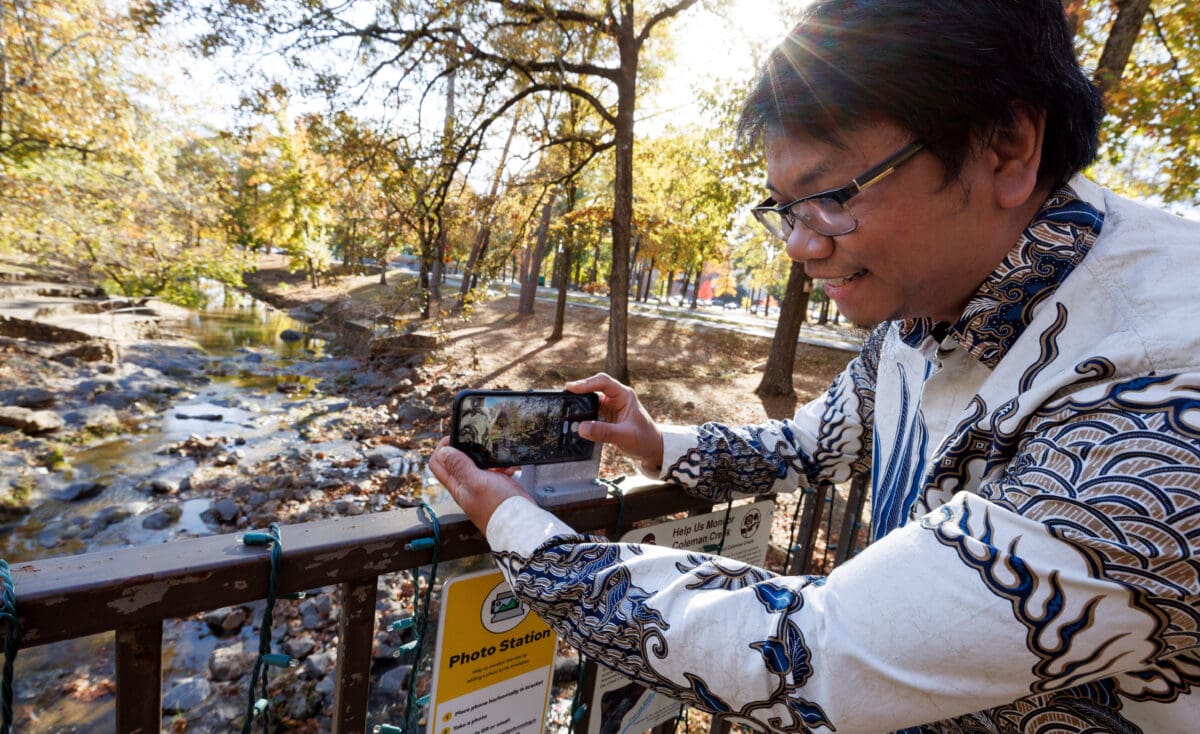
His new project is built to capture changes like that one. With funding from the university’s Sustainability Committee Grant, Hanafi set up three Chronolog monitoring stations on campus in September. At each station, passersby can place their phone in a fixed bracket, take a photo, and share it to the Chronolog server. Because every image is taken from the same angle, the photos combine into a time-lapse that shows how the sites change over time.
The stations sit at three points along Coleman Creek. The first stands on a bridge overlooking the Coleman Creek Amphitheater and the creek, facing south down the creek towards West 32nd Street. The other two are on the West 32nd Street bridge over the creek, one facing north and one facing south. Together, they let visitors track changes in water levels, creek banks, vegetation growth, and fish populations.
Hanafi said the main goal is “to increase awareness of how important the creek is to the local community and to the campus.” He also hopes the project will encourage people to help protect the creek’s health and show them where its water goes, downstream into the Fourche Creek Preserve, which flows into the Arkansas River.
The photos also have scientific value.
They let researchers “monitor how the creekbed and banks erode in real time,” Hanafi said, and the water levels in the images can be compared with hydrology and weather data.
“I’m also hoping it will become a tool that biologists and others can use in research,” he said.
About 70 contributions have been made so far, and Hanafi described the effort as “a project that everyone can be involved in,” adding that he wants the whole Little Rock community to know that the stations and data from the photos are open to anyone.
He would also like to explore partnerships with the city or state parks. UA Little Rock is one of only three Chronolog sites in Arkansas, Hanafi said, placing it within a global network that has over 100,000 contributors across 300 organizations.
The Sustainability Committee Grant is open to all faculty, staff, and students, with awards of up to $2,500 for ideas that make the campus more sustainable.
“We hope that many different ideas come to life, so that our campus becomes a more sustainable place and more people on campus take an interest in sustainability,” said Kyungsun Lee, assistant professor of geography in the Department of History and chair of the Sustainability Grant Committee. “This matters because campus is where many of us work and study, and where we spend so much of our time.”
Lee said the review committee weighs sustainability impact, feasibility, campus community engagement, and creativity. The Chronolog project stood out as well designed, with a reasonable budget, and was highly feasible because it builds on an existing program. Its photos document the campus environment and could support future conversations about sustainability at UA Little Rock.
“The committee especially valued that anyone on campus, even someone just walking by, can take part, so the benefits reach the whole campus community,” Lee said.
Hanafi, a structural geologist who specializes in structural geology and tectonics, encourages others with strong ideas to follow his lead in applying for sustainability grants.
“The sustainability committee is a great initiative and really believes in the long-term sustainability of the campus,” he said.
The call for proposals opens every fall, and faculty, staff, and students can apply individually or as a team. Awards cover equipment and other items needed for a project. Lee encourages anyone with an idea to start developing it now and to contact her at [email protected] to talk it through before the next call. More information is available on the Grant Competitions page.
Individuals can view the project, or contribute photos, online, as well.